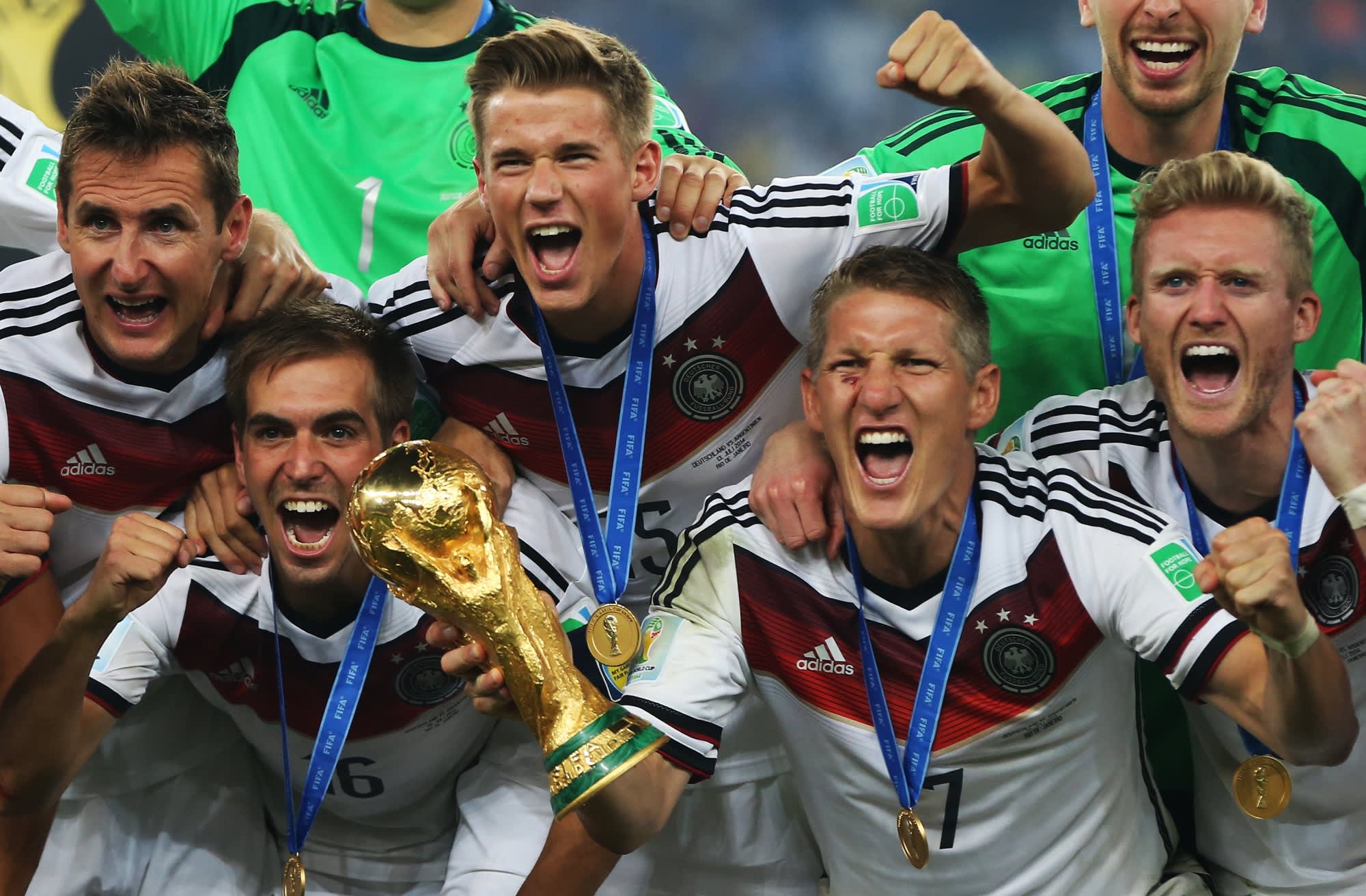
The FIFA World Cup Trophy carries an estimated value of $20 million, making it the most expensive trophy in professional sports.
The actual gold inside it is worth roughly $250,000 at current market prices. That gap is not a mystery. It is where prestige lives, and this article explains exactly how it is built.
The Short Answer: What the World Cup Trophy is Worth
There are three numbers that matter when valuing the World Cup Trophy, and they tell very different stories depending on what you are measuring.
| What You Are Measuring | Value |
| Raw gold content (melt value) | ~$250,000 |
| Production cost to recreate today | ~$242,700 |
| Total artifact valuation (expert estimate) | ~$20 million |
The trophy is made of 18-karat gold and weighs 6.175 kilograms. Of that total weight, 75% is pure gold, approximately 4.93 kilograms. Based on gold prices as of mid-2025, that raw material value comes out to roughly $250,000.
The complete trophy is valued at approximately $20 million by sports valuation experts, making it the single most expensive sporting prize in the world.
The Woodlawn Vase, awarded to the winner of the Preakness Stakes and considered the second most valuable sporting trophy, is not particularly close.
The $19.75 million difference between melt value and artifact value is entirely intangible. The next section explains exactly where it comes from.
What the Trophy is Actually Made Of?
Before you can understand the valuation, you need to understand the object. The trophy is not what most people picture when they hear “solid gold.”
It is hollow. The FIFA World Cup Trophy is hollow on the inside, confirmed by its original manufacturer GDE Bertoni and validated independently by chemist Sir Martyn Poliakoff.
If the trophy were solid 18-karat gold at its actual dimensions, it would weigh somewhere between 70 and 80 kilograms.
No player lifts that above their head after 120 minutes of football. The hollow construction brings the weight to a manageable 6.175 kilograms.
| Specification | Measurement |
| Height | 36.8 cm (14.5 inches) |
| Base diameter | 13 cm (5.1 inches) |
| Total weight | 6.175 kg (13.6 lbs) |
| Gold content | ~5.0 kg of 18-karat gold |
| Malachite base weight | ~1.175 kg |
| Gold purity | 75% (18-karat) |
The base is made of two bands of malachite, a deep green semi-precious stone that adds 1.175 kilograms to the total weight. It also serves as the trophy’s historical record.
The names of every World Cup winner since 1974 are engraved on the underside in each nation’s own language. “1974 Deutschland.” “1994 Brasil.” “2022 Argentina.” A spiral engraving arrangement was adopted in 2014 to make room for future winners as space on the base grows limited.
The trophy was designed by Italian artist Silvio Gazzaniga and manufactured by GDE Bertoni in Paderno Dugnano, Italy. Gazzaniga’s design depicts two human figures rising in spirals, arms raised, holding up the Earth.
It was selected from 53 submissions by sculptors across seven countries following a FIFA design competition after Brazil earned permanent custody of the original Jules Rimet Trophy in 1970. The same trophy has been used at every World Cup since 1974.
Why the Trophy is Worth $20 Million? (Not Just $250,000)
This is the question almost no article actually answers. Every piece states the $20 million figure. Almost none explain where it comes from.
The trophy is not valued like gold. It is valued like a one-of-a-kind historical artifact, and those follow a completely different logic.
Precious metal content is the floor of a trophy’s value, not the ceiling. When appraisers put a number on a sporting artifact at this level, they work with three layers:
- Material value — the gold content, approximately $250,000
- Historical significance — what has happened with this specific object over five decades
- Symbolic irreplaceability — whether any amount of money could produce an equivalent substitute
The World Cup Trophy scores at the extreme end of all three. Its $20 million valuation is not a gold price calculation.
It is an artifact assessment, the same framework applied to original Olympic medals or game-worn jerseys, pushed to its logical extreme by the combination of global scale, unbroken physical lineage, and FIFA’s permanent control over the object.
The Vince Lombardi Trophy is recast from scratch every year. The Champions League trophy has been remade multiple times. The Stanley Cup is continuously modified with new rings.
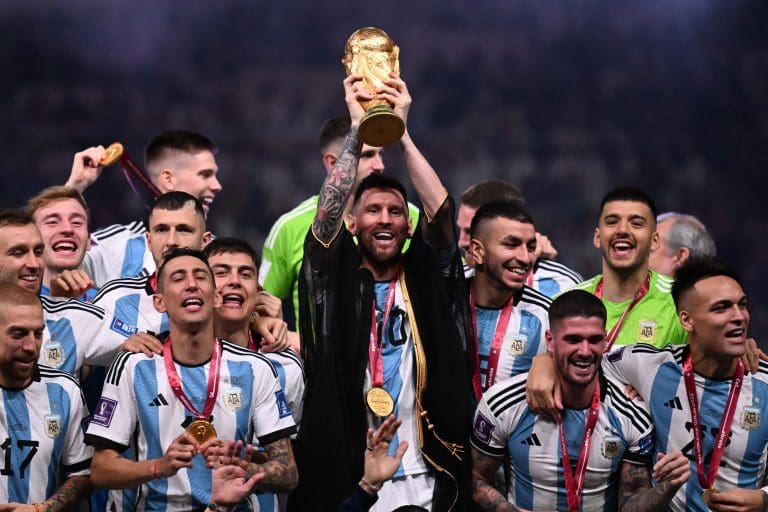
The FIFA World Cup Trophy is the same physical object that Franz Beckenbauer lifted in 1974, that Maradona held in 1986, that Ronaldo raised in 2002, that Messi got his hands on in 2022.
There is exactly one. It is not for sale. No auction could produce it. That unbroken lineage, one object touching the hands of every generation’s greatest players, is where the premium lives. You cannot manufacture it with new gold.
Is the World Cup Trophy Solid Gold?
No. The trophy is made of 18-karat gold but it is hollow on the inside. FIFA’s own language contributes to the confusion.
Official communications describe the trophy as “solid gold,” which refers to the material type rather than the structural construction.
A solid 18-karat gold trophy at the same dimensions would weigh approximately 70 to 80 kilograms, roughly the weight of a fully grown adult.
Players lift this trophy above their heads immediately after winning a World Cup final, exhausted, often after extra time and a penalty shootout.
A hollow structure brings the weight to 6.175 kilograms. That is substantial enough to feel significant and manageable enough to hoist one-handed.
18-karat means 75% pure gold mixed with 25% other metals. In this case, silver and copper.
The alloy gives the trophy its deep yellow color and adds the durability that pure gold, which is relatively soft, could not provide on its own. This is why FIFA can officially describe the trophy as gold while the construction is technically hollow.
The History Behind the Trophy: Jules Rimet to Today
The current trophy is not the original. Understanding the history of the two trophies explains why the current one exists, why it never leaves FIFA’s possession, and why the rules around it are what they are.
The original Jules Rimet Trophy (1930 to 1970)
The first trophy was called Victory before being renamed in honor of FIFA president Jules Rimet in 1946.
It was made of gold-plated sterling silver on a lapis lazuli base and depicted Nike, the Greek goddess of victory, holding a cup aloft.
French sculptor Abel Lafleur designed it. It stood 35 centimeters tall and weighed 3.8 kilograms. Compared to the current trophy, it was delicate in both weight and construction.
Brazil wins it permanently, then it is stolen
Under Jules Rimet’s original rules, the first nation to win three World Cups would keep the trophy forever. Brazil reached that threshold in 1970. The Jules Rimet Trophy went to Rio de Janeiro, and FIFA commissioned a replacement.
Then in 1983, the trophy was stolen from a display case at the Brazilian Football Confederation headquarters and never recovered.
Most experts believe it was melted down for its gold content. History destroyed for material worth a fraction of its value as an artifact.
The 1974 redesign and every winner since
The current trophy debuted at the 1974 World Cup in West Germany and has been awarded to every champion since:
- 1978, 1986, 2022: Argentina
- 1982, 2006: Italy
- 1990, 2014: Germany / West Germany
- 1994, 2002: Brazil
- 1998, 2018: France
- 2010: Spain
The 2026 winner will be the thirteenth nation engraved on the base.
Can the Winners Keep the World Cup Trophy?
No. Winning teams do not keep the original. They receive a replica. This has been the rule since 1974.
Every World Cup winner takes home the FIFA World Cup Winners’ Trophy, a gold-plated bronze replica designed to closely resemble the original.
The differences are material rather than visual. It has a bronze core instead of gold, gold plating over the surface rather than solid gold construction, and a lighter overall weight.
Individual players receive their own replicas and keep them permanently. The original returns to the FIFA Museum in Zurich, where it is kept in the FIFA World Cup Gallery and leaves only for the pre-tournament trophy tour, the draw event, the opening match, and the final.
The three-time winner rule that gave Brazil permanent custody of the Jules Rimet Trophy does not apply to the current trophy.
Brazil, with five World Cups and more than any other nation, has not been offered the original. No future multi-winner will be either. The rule died with the Jules Rimet.
Who is Allowed to Touch the Real Trophy?
Almost nobody. FIFA maintains a strict protocol around bare-handed contact with the original. The permitted list is short:
- World Cup winners — players and managers who have won the tournament
- Heads of state and national leaders
- Select FIFA officials, including the FIFA president
In August 2025, FIFA president Gianni Infantino handed the trophy to Donald Trump during an Oval Office event announcing the 2026 World Cup draw date.
Infantino explained on camera: “Only the FIFA president, presidents of countries and then those who win can touch it, because this is for winners only.” Trump asked if he could keep it. He could not.
The controls tightened after each theft. The 1966 theft in London was recovered a week later by a dog named Pickles. The 1983 theft in Rio ended with the trophy almost certainly being melted.
Today the trophy travels under 24-hour security when it leaves Zurich. The touch protocol is not ceremonial gatekeeping. It is the direct result of losing two trophies.
The 2026 World Cup: Trophy vs. Prize Money
The final takes place July 19 at MetLife Stadium in New Jersey. Whoever lifts the trophy there will also take home $50 million in prize money, the largest winner’s payout in World Cup history.
| Tournament | Winner’s Prize Money |
| 2014 Brazil | $35 million |
| 2018 Russia | $38 million |
| 2022 Qatar | $42 million |
| 2026 USA / Canada / Mexico | $50 million |
FIFA officially confirmed $655 million in total prize funds across all 48 participating nations in 2026, a 50% increase over the 2022 edition. The $50 million winner’s check is real and immediate. The $20 million trophy valuation is theoretical.
FIFA will never sell it, so the number functions more as a measure of cultural significance than a market price. What the trophy actually represents cannot be priced. It is the same object, at the sport’s highest moment, for over fifty years running.
FAQs
How much is the World Cup trophy worth?
The FIFA World Cup Trophy is valued at an estimated $20 million, making it the most expensive trophy in professional sports. The gold content alone is worth approximately $250,000 at current market prices.
Is the World Cup trophy made of real gold?
Yes. The trophy is made of 18-karat gold, which is 75% pure gold mixed with silver and copper for durability. It is not solid all the way through. The inside is hollow, which keeps the total weight at 6.175 kilograms rather than the 70 to 80 kilograms a solid gold version would weigh.
How much does the World Cup trophy weigh?
The trophy weighs 6.175 kilograms in total. The gold construction accounts for approximately 5 kilograms and the malachite base adds the remaining 1.175 kilograms.
Can the winning team keep the World Cup trophy?
No. The original trophy stays with FIFA and is kept at the FIFA Museum in Zurich. Winning nations receive a gold-plated bronze replica. Individual players each receive their own replica to keep permanently.
Who is allowed to touch the World Cup trophy?
FIFA restricts bare-handed contact to three groups: players and managers who have won the World Cup, heads of state, and select FIFA officials including the FIFA president. The rule exists because the original Jules Rimet Trophy was stolen twice, with the 1983 theft resulting in it being melted down and never recovered.
What happened to the original World Cup trophy?
The original Jules Rimet Trophy was given to Brazil in 1970 after they won their third World Cup. In 1983 it was stolen from the Brazilian Football Confederation headquarters in Rio de Janeiro and never found. Most experts believe it was melted down for its gold content.
How much will the 2026 World Cup winner receive in prize money?
The winner of the 2026 FIFA World Cup will receive $50 million in prize money, up from $42 million at the 2022 tournament in Qatar. FIFA has set aside $655 million in total prize funds across all 48 participating nations.
What is the World Cup trophy made of?
The trophy is made of 18-karat gold with a base of two bands of malachite, a green semi-precious stone. It was designed by Italian sculptor Silvio Gazzaniga and manufactured by GDE Bertoni in Italy. It stands 36.8 centimeters tall and has been used at every World Cup since 1974.