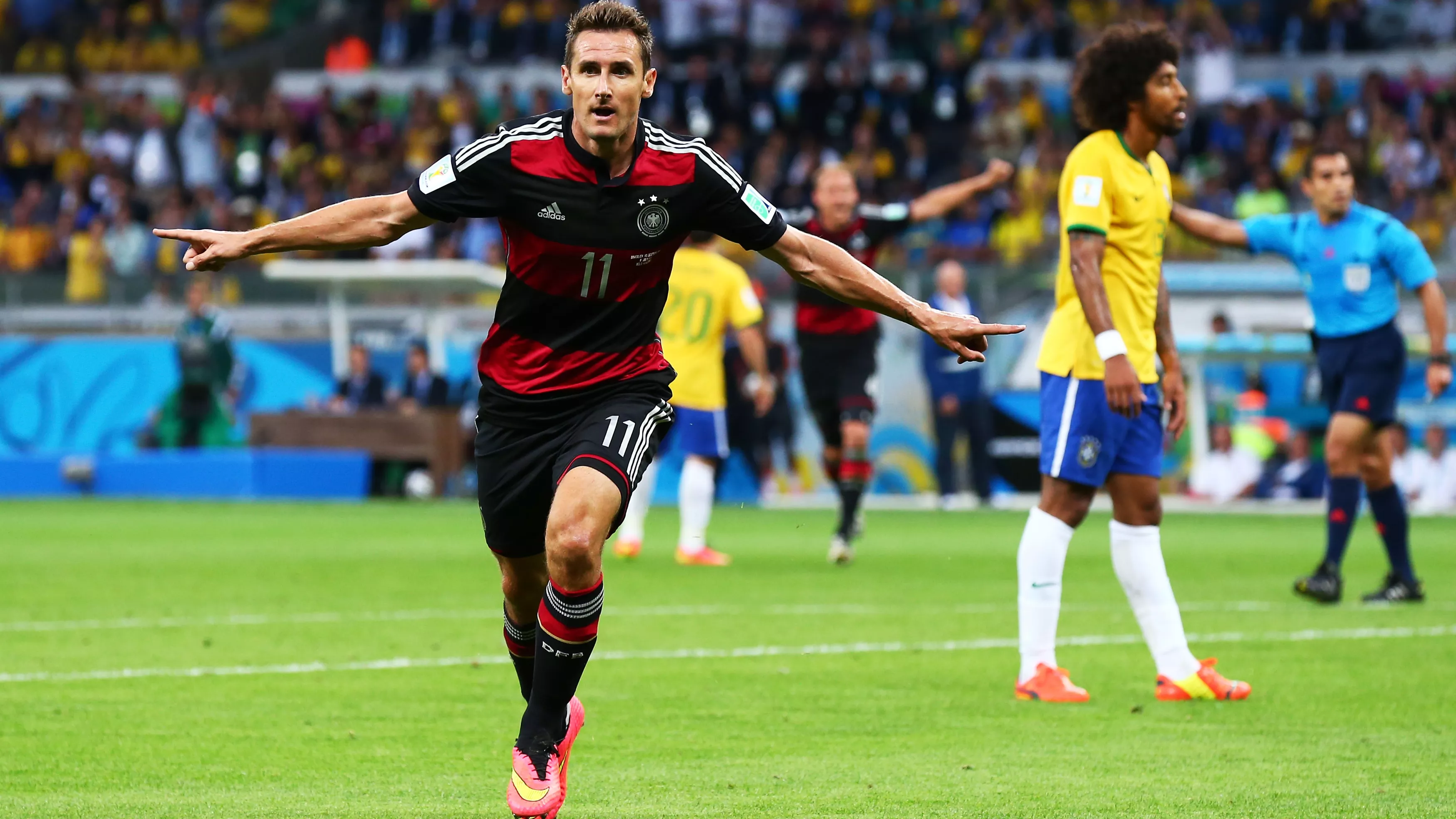
When Germany lined up against Brazil in the 2014 World Cup semifinal, few realized they were about to witness history.
Miroslav Klose scored his 16th World Cup goal that night, breaking a record many thought would never fall.
The record had stood for nearly four decades. Brazil’s Ronaldo had scored 15 goals across three tournaments, and that mark seemed untouchable. But Klose’s scoring pattern tells a different story than most legendary strikers.
He didn’t rely on dominant single-tournament performances. Instead, he built his legacy through remarkable consistency across four World Cups, scoring in each one from 2002 to 2014.
This sustained excellence at football’s biggest stage separated him from every other striker in the tournament’s history.
You’ll learn exactly how Klose accumulated these goals, which tournaments produced his best returns, and the complete breakdown of every goal that built his record.
Complete Goal Statistics Breakdown
Klose scored 16 goals across 24 World Cup matches between 2002 and 2014. That’s a goal every 1.5 games, sustained over 12 years.
Tournament-by-Tournament Statistics
| Tournament | Matches Played | Goals Scored | Minutes Played | Goals per Match | Tournament Finish |
| 2002 (South Korea/Japan) | 7 | 5 | 515 | 0.71 | Runner-up |
| 2006 (Germany) | 7 | 5 | 611 | 0.71 | Third place |
| 2010 (South Africa) | 6 | 4 | 447 | 0.67 | Third place |
| 2014 (Brazil) | 4 | 2 | 117 | 0.50 | Champions |
| Total | 24 | 16 | 1,690 | 0.67 | – |
The breakdown shows steady production rather than explosive tournaments.
He scored 5 goals in 2002, 5 in 2006, 4 in 2010, and 2 in 2014. Most top scorers peak in one tournament and fade. Klose delivered across four.
Goal Distribution by Match Stage
| Stage | Goals | Matches | Conversion Rate |
| Group Stage | 11 | 12 | 91.7% |
| Round of 16 | 2 | 4 | 50.0% |
| Quarter-finals | 3 | 4 | 75.0% |
| Semi-finals | 1 | 4 | 25.0% |
| Final | 0 | 2 | 0.0% |
Group stage dominance stands out. 11 of his 16 goals came in the opening rounds, when Germany typically faced weaker opponents.
Every Goal: Complete Match-by-Match Record
2002 World Cup (5 Goals)
| Goal # | Date | Opponent | Stage | Minute | Type | Assist | Result |
| 1 | June 1 | Saudi Arabia | Group | 20′ | Header | Ballack | 8-0 W |
| 2 | June 1 | Saudi Arabia | Group | 25′ | Header | Linke | 8-0 W |
| 3 | June 1 | Saudi Arabia | Group | 70′ | Header | Bode | 8-0 W |
| 4 | June 5 | Ireland | Group | 19′ | Header | Ballack | 1-1 D |
| 5 | June 11 | Cameroon | Group | 79′ | Header | Neuville | 2-0 W |
All five goals at his first World Cup came from headers. The hat-trick against Saudi Arabia at the Sapporo Dome announced him on the world stage.
He finished as joint second-highest scorer alongside Rivaldo, behind Ronaldo’s 8 goals, earning the Silver Boot.
2006 World Cup (5 Goals)
| Goal # | Date | Opponent | Stage | Minute | Type | Assist | Result |
| 6 | June 9 | Costa Rica | Group | 17′ | Right foot | Schweinsteiger | 4-2 W |
| 7 | June 9 | Costa Rica | Group | 61′ | Right foot | – | 4-2 W |
| 8 | June 20 | Ecuador | Group | 4′ | Header | Borowski | 3-0 W |
| 9 | June 20 | Ecuador | Group | 44′ | Right foot | Frings | 3-0 W |
| 10 | June 30 | Argentina | QF | 80′ | Header | Ballack | 1-1 D (4-2 pens) |
Playing at home increased expectations. Klose delivered 5 goals in 7 matches, winning the Golden Boot as the tournament’s top scorer.
Two braces against Costa Rica and Ecuador in the group stage, plus the 80th-minute equalizer against Argentina that forced penalties.
2010 World Cup (4 Goals)
| Goal # | Date | Opponent | Stage | Minute | Type | Assist | Result |
| 11 | June 13 | Australia | Group | 26′ | Header | Podolski | 4-0 W |
| 12 | June 27 | England | R16 | 20′ | Right foot | – | 4-1 W |
| 13 | July 3 | Argentina | QF | 68′ | Right foot | Schweinsteiger | 4-0 W |
| 14 | July 3 | Argentina | QF | 89′ | Right foot | Ozil | 4-0 W |
The goal against England equalled Pele for fourth on the all-time list. Against Argentina, Klose reached his 100th cap and scored twice to equal Gerd Muller’s German World Cup record of 14 goals.
2014 World Cup (2 Goals)
| Goal # | Date | Opponent | Stage | Minute | Type | Assist | Result |
| 15 | June 16 | Ghana | Group | 71′ | Right foot | – | 2-2 D |
| 16 | July 8 | Brazil | SF | 23′ | Right foot | Kroos | 7-1 W |
At 36 years old, Klose’s role changed. He started just one group stage match but came off the bench in the semifinal against Brazil. When he scored in the 23rd minute of that 7-1 victory, he broke Ronaldo’s record.
Goal-Scoring Methods Analysis
Goals by Technique
| Method | Goals | Percentage |
| Headers | 7 | 43.8% |
| Right foot | 8 | 50.0% |
| Left foot | 1 | 6.2% |
Klose became the first player to score five headers in a FIFA World Cup during 2002. Seven of his 16 total World Cup goals came from headers, more than any player in tournament history.
Goals by Location in Penalty Area
| Zone | Goals | Description |
| Six-yard box | 8 | Inside the goal area |
| Penalty area (6-18 yards) | 7 | Between six-yard and penalty spot |
| Outside penalty area | 1 | Beyond 18-yard line |
Klose’s predatory instincts showed in positioning. 15 of 16 goals came from inside the penalty area, with 8 scored from the six-yard box where he excelled at converting crosses and rebounds.
Game Situations
| Situation | Goals |
| Open play | 11 |
| Set pieces (corners/free kicks) | 4 |
| Counter-attacks | 1 |
Most goals came from fluid attacking play rather than set pieces, though his aerial ability made him dangerous from corners.
All-Time World Cup Top Scorers Complete Comparison
| Rank | Player | Goals | Tournaments | Matches | Goals/Match | Years Active | Tournaments Won |
| 1 | Miroslav Klose (GER) | 16 | 4 (2002-2014) | 24 | 0.67 | 12 years | 1 (2014) |
| 2 | Ronaldo (BRA) | 15 | 4 (1994-2006) | 19 | 0.79 | 12 years | 2 (1994, 2002) |
| 3 | Gerd Muller (GER) | 14 | 2 (1970-1974) | 13 | 1.08 | 4 years | 1 (1974) |
| 4 | Just Fontaine (FRA) | 13 | 1 (1958) | 6 | 2.17 | 0 years | 0 |
| T5 | Pele (BRA) | 12 | 4 (1958-1970) | 14 | 0.86 | 12 years | 3 (1958, 1962, 1970) |
| T5 | Kylian Mbappe (FRA) | 12 | 2 (2018-2022) | 14 | 0.86 | 4 years | 1 (2018) |
| T7 | Sandor Kocsis (HUN) | 11 | 1 (1954) | 5 | 2.20 | 0 years | 0 |
| T7 | Jurgen Klinsmann (GER) | 11 | 3 (1990-1998) | 17 | 0.65 | 8 years | 1 (1990) |
| 9 | Helmut Rahn (GER) | 10 | 2 (1954-1958) | 10 | 1.00 | 4 years | 1 (1954) |
| T10 | Gary Lineker (ENG) | 10 | 2 (1986-1990) | 12 | 0.83 | 4 years | 0 |
| T10 | Gabriel Batistuta (ARG) | 10 | 3 (1994-2002) | 12 | 0.83 | 8 years | 0 |
| T10 | Teofilo Cubillas (PER) | 10 | 3 (1970-1982) | 13 | 0.77 | 12 years | 0 |
| T10 | Thomas Muller (GER) | 10 | 3 (2010-2022) | 18 | 0.56 | 12 years | 1 (2014) |
Klose’s longevity stands out. Only Pele, Ronaldo, and Cubillas matched his four-tournament span, but none surpassed his goal total.
Germany’s World Cup Performance During Klose Era
Tournament Results (2002-2014)
| Year | Host | Stage Reached | Matches | Wins | Draws | Losses | Goals For | Goals Against |
| 2002 | KOR/JPN | Final | 7 | 5 | 1 | 1 | 14 | 3 |
| 2006 | GER | 3rd Place | 7 | 5 | 1 | 1 | 14 | 6 |
| 2010 | RSA | 3rd Place | 7 | 5 | 0 | 2 | 16 | 5 |
| 2014 | BRA | Champions | 7 | 6 | 1 | 0 | 18 | 4 |
| Total | – | – | 28 | 21 | 3 | 4 | 62 | 18 |
Germany’s consistency gave Klose 28 World Cup matches, more than most strikers see in their careers. The team reached at least the semifinals in all four tournaments, with 21 wins in 28 matches.
Klose’s Contribution to Germany Goals
| Tournament | Germany Goals | Klose Goals | Percentage |
| 2002 | 14 | 5 | 35.7% |
| 2006 | 14 | 5 | 35.7% |
| 2010 | 16 | 4 | 25.0% |
| 2014 | 18 | 2 | 11.1% |
| Total | 62 | 16 | 25.8% |
Klose scored more than one-quarter of all German goals during his four World Cups.
Complete International Goal Record
All Competition Breakdown
| Competition | Matches | Goals | Assists | Goals/Match |
| FIFA World Cup | 24 | 16 | 2 | 0.67 |
| World Cup Qualifiers | 45 | 13 | 7 | 0.29 |
| UEFA European Championship | 13 | 3 | 3 | 0.23 |
| Euro Qualifiers | 30 | 16 | 5 | 0.53 |
| Friendly Matches | 25 | 23 | 7 | 0.92 |
| Total | 137 | 71 | 24 | 0.52 |
In addition to his 16 goals in World Cup finals, Klose scored another 13 in qualification games, as well as three goals in UEFA European Championship finals and 16 in that tournament’s qualification matches.
Goals by Opponent (Top 10)
| Opponent | Goals | Matches | Goals/Match |
| Austria | 6 | 9 | 0.67 |
| Sweden | 5 | 7 | 0.71 |
| Azerbaijan | 5 | 4 | 1.25 |
| Saudi Arabia | 3 | 1 | 3.00 |
| Argentina | 3 | 4 | 0.75 |
| Ecuador | 2 | 1 | 2.00 |
| Costa Rica | 2 | 1 | 2.00 |
| Australia | 2 | 3 | 0.67 |
| Poland | 2 | 3 | 0.67 |
| Brazil | 2 | 5 | 0.40 |
Against weaker opposition like Azerbaijan, Klose’s conversion rate peaked. Against top teams like Brazil and Argentina, he still delivered crucial goals in knockout matches.
Club Career Statistics for Context
Bundesliga Performance
| Club | Years | Matches | Goals | Assists | Goals/Match |
| Kaiserslautern | 2000-2004 | 89 | 53 | 14 | 0.60 |
| Werder Bremen | 2004-2007 | 86 | 63 | 32 | 0.73 |
| Bayern Munich | 2007-2011 | 98 | 24 | 14 | 0.24 |
| Total Bundesliga | 1999-2011 | 273 | 140 | 60 | 0.51 |
After plundering 53 goals in 89 Bundesliga games for Kaiserslautern, Klose found career-best form at Bremen.
He scored 25 goals in the 2005-06 campaign to claim his first and only Bundesliga top scorer’s cannon.
In 2005-06 and 2006-07, he also finished as the division’s top provider with a combined 28 assists.
Serie A Performance (Lazio)
| Season | Matches | Goals | Assists | Goals/Match |
| 2011-12 | 31 | 13 | 4 | 0.42 |
| 2012-13 | 29 | 15 | 5 | 0.52 |
| 2013-14 | 23 | 9 | 6 | 0.39 |
| 2014-15 | 33 | 13 | 7 | 0.39 |
| 2015-16 | 23 | 2 | 3 | 0.09 |
| Total | 139 | 52 | 25 | 0.37 |
Between 2011 and 2016, Klose produced 63 goals and 35 assists in 171 appearances for Lazio, whilst helping them beat city rivals Roma in the 2012-13 Coppa Italia final.
Signature Characteristics
Heading Excellence Analysis
Physical Attributes:
- Height: 1.82m (6’0″)
- Jump reach: Approximately 2.85m
- Timing: Elite-level anticipation
Heading Success Factors:
- Spatial awareness before ball arrival
- Vertical leap 15-20% above average for his height
- Neck strength for powerful direction changes
- Front-post and back-post runs equally effective
His aerial ability and timing on crosses consistently beat taller defenders. The 7 headed World Cup goals remain unmatched in tournament history.
Goal Celebration: The Salto-Klose
Klose’s trademark front-flip celebration became iconic:
- First performed: Germany debut vs Albania (2001)
- Most famous: Hat-trick vs Saudi Arabia (2002)
- Final flip: Unknown (phased out after 2006)
- Nickname origin: “Salto” (German for somersault)
The acrobatic celebration earned him the nickname “Salto-Klose” after performing it following goals at the 2002 World Cup.
Individual Honors and Achievements
Awards and Recognition
- 2002: FIFA World Cup Silver Boot (5 goals, 2nd place)
- 2006: FIFA World Cup Golden Boot (5 goals, sole winner)
- 2006: German Footballer of the Year
- 2006, 2010: FIFA World Cup All-Star Team
- 2014: FIFA World Cup Winner
- 2014: Silver Laurel Leaf (Germany’s highest sporting honor)
Career Milestones
| Date | Achievement | Details |
| March 24, 2001 | Germany debut goal | Winning goal vs Albania (2-1) |
| June 1, 2002 | First World Cup hat-trick | 3 headers vs Saudi Arabia |
| June 20, 2006 | 10th World Cup goal | Equaled Gerd Muller |
| June 27, 2010 | 12th World Cup goal | Equaled Pele |
| July 3, 2010 | 100th Germany cap | vs Argentina (scored twice) |
| July 3, 2010 | 14th World Cup goal | Equaled Ronaldo |
| June 6, 2014 | 69th international goal | Surpassed Muller as Germany’s top scorer |
| July 8, 2014 | 16th World Cup goal | All-time record vs Brazil |
| July 13, 2014 | World Cup winner | Final vs Argentina |
Active Players Chasing the Record
Current Standing (as of 2026)
| Player | Age | Goals | Tournaments | Projected Tournaments Remaining |
| Kylian Mbappe | 27 | 12 | 2 | 2-3 (2026, 2030, possibly 2034) |
| Harry Kane | 32 | 8 | 2 | 1-2 (2026, possibly 2030) |
| Cristiano Ronaldo | 41 | 8 | 5 | 0 (retired from World Cup) |
| Lionel Messi | 38 | 13 | 5 | 0 (retired from World Cup) |
Mbappe’s Path to 17 Goals:
- Needs: 5 goals
- Realistic scenario: 2-3 in 2026, 2-3 in 2030
- Challenges: Injury risk, France’s tournament success, competition rotation
Kane’s Path to 17 Goals:
- Needs: 9 goals
- Realistic scenario: 3-4 in 2026, unlikely to reach 2030 at age 36
- Challenges: Age, England’s knockout record, fitness longevity
Post-Retirement Coaching Career
Coaching Timeline
| Period | Role | Team |
| 2016-2021 | Assistant Coach | Germany National Team |
| 2020-2021 | U17 Coach | Bayern Munich |
| 2021-2023 | Assistant Coach | Bayern Munich (First Team) |
| 2023-2024 | Head Coach | SCR Altach (Austria) |
| 2024-present | Head Coach | 1. FC Nürnberg |
Klose transitioned from player to coach, maintaining connections with German football’s top programs.
FAQs
Can Mbappe break Klose’s World Cup goal record?
Kylian Mbappe has the best chance with 12 goals by age 23. If he plays in 2026 and 2030, he needs 5 more goals across potentially 10-12 matches. His pace of 0.86 goals per match exceeds Klose’s 0.67. Two factors favor Mbappe: youth (27 in 2026, 31 in 2030) and France’s consistent tournament success. However, 2026’s expanded 48-team format could dilute knockout round opportunities if France dominates the group stage.
How many World Cup finals did Klose play in?
Klose played in two World Cup finals. Germany lost 2-0 to Brazil in 2002 when Klose was 24. He won the 2014 final against Argentina as a 36-year-old substitute, coming on in the 88th minute. The 12-year gap between finals appearances shows his remarkable longevity at international level.
What was Klose’s record-breaking goal like?
The 16th goal against Brazil in the 2014 semifinal came in the 23rd minute of a 7-1 victory. Toni Kroos delivered a corner kick that bounced around Brazil’s penalty area. Klose reacted quickest to the loose ball and scored from close range, typical of his predatory instincts in the box. The goal put Germany ahead 2-0 and broke an 8-year-old record.
Did Klose win any Golden Boot awards?
Klose won the 2006 Golden Boot as the tournament’s sole leading scorer with 5 goals in Germany. He shared the award with no one else. In 2002, he won the Silver Boot as second-highest scorer behind Ronaldo’s 8 goals. Despite leading the all-time scoring list, he never won a solo Golden Boot because his goals spread across four tournaments rather than concentrating in one.
What made Klose’s heading ability special?
Seven of Klose’s 16 World Cup goals came from headers, more than any player in tournament history. At 6 feet tall, he wasn’t the biggest striker, but his timing and spatial awareness before the ball arrived gave him an edge. His vertical leap reached approximately 15-20% above average for his height. Coaches praised his ability to read flight paths and arrive at crossing points exactly when needed.
How old was Klose when he scored his last World Cup goal?
Klose was 36 years and 4 days old when he scored against Brazil in the 2014 semifinal. That made him the second-oldest player to score in a World Cup semifinal. His fitness level and positioning sense compensated for declining pace, allowing him to compete against defenders 10 years younger. He retired from international football one month after winning the tournament.