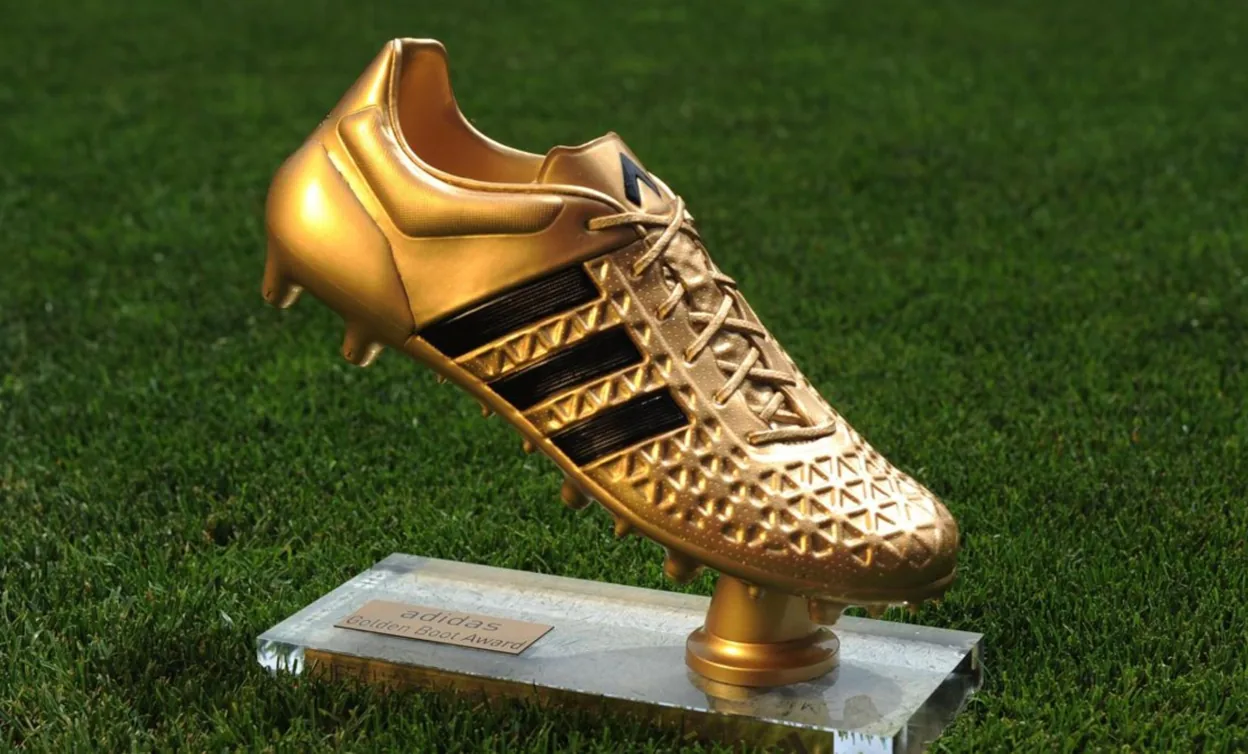
The World Cup Golden Boot goes to the top goalscorer at every FIFA World Cup.
The award has been officially presented since 1982, first as the Golden Shoe, then renamed the Golden Boot in 2010.
FIFA retroactively recognises top scorers all the way back to the first tournament in 1930.
The numbers at either end of history tell the story well. Just Fontaine scored 13 goals in six games at the 1958 World Cup, a record that still stands today.
At the other end of the timeline, Kylian Mbappé bagged eight goals at the 2022 tournament in Qatar, including a hat-trick in the final against Argentina.
This page covers every winner from 1930 to 2022, the all-time records buried in that data, how the tiebreaker system works with real examples, which countries produce the most top scorers, and what to expect at the 2026 FIFA World Cup.
World Cup Golden Boot Winners — Complete List (1930–2026)
The award was officially launched in 1982 under the name Golden Shoe, then rebranded as the Golden Boot in 2010.
FIFA recognises all top scorers retroactively from 1930 across all 22 tournaments. One important rule: goals scored in penalty shootouts do not count toward a player’s total.
| Year | Host | Winner | Country | Goals |
|---|---|---|---|---|
| 1930 | Uruguay | Guillermo Stábile | Argentina | 8 |
| 1934 | Italy | Oldřich Nejedlý | Czechoslovakia | 5 |
| 1938 | France | Leônidas | Brazil | 7 |
| 1950 | Brazil | Ademir | Brazil | 8 |
| 1954 | Switzerland | Sándor Kocsis | Hungary | 11 |
| 1958 | Sweden | Just Fontaine | France | 13 |
| 1962 | Chile | Garrincha / Vavá / Leonel Sánchez / Dražan Jerković / Valentin Ivanov / Florian Albert | Multiple (6-way tie) | 4 |
| 1966 | England | Eusébio | Portugal | 9 |
| 1970 | Mexico | Gerd Müller | West Germany | 10 |
| 1974 | West Germany | Grzegorz Lato | Poland | 7 |
| 1978 | Argentina | Mario Kempes | Argentina | 6 |
| 1982 | Spain | Paolo Rossi | Italy | 6 |
| 1986 | Mexico | Gary Lineker | England | 6 |
| 1990 | Italy | Salvatore Schillaci | Italy | 6 |
| 1994 | USA | Hristo Stoichkov / Oleg Salenko (shared) | Bulgaria / Russia | 6 |
| 1998 | France | Davor Šuker | Croatia | 6 |
| 2002 | South Korea / Japan | Ronaldo | Brazil | 8 |
| 2006 | Germany | Miroslav Klose | Germany | 5 |
| 2010 | South Africa | Thomas Müller | Germany | 5 |
| 2014 | Brazil | James Rodríguez | Colombia | 6 |
| 2018 | Russia | Harry Kane | England | 6 |
| 2022 | Qatar | Kylian Mbappé | France | 8 |
| 2026 | USA / Canada / Mexico | Kylian Mbappé | France | 10 |
The 1962 six-way tie is the most unusual entry in World Cup history.
Flórián Albert, Valentin Ivanov, Garrincha, Vavá, Dražan Jerković, and Leonel Sánchez all finished on four goals.
Because no tiebreaker rules existed at the time, all six players shared the honour equally.
World Cup Golden Boot Records and Key Stats
Most Goals in a Single Tournament
Just Fontaine of France scored 13 goals in six games at the 1958 World Cup in Sweden. That record has stood for over 65 years and remains untouched.
What makes it even more extraordinary is that Fontaine played the entire tournament in borrowed boots after his own pair was damaged before the competition started.wikipedia+1
Only three other players have ever come close to that tally. Sándor Kocsis scored 11 in 1954, Gerd Müller hit 10 in 1970, and Eusébio reached nine in 1966.
Every other Golden Boot winner since 1970 has finished with eight goals or fewer, which shows just how far ahead of the field Fontaine’s record still sits.
| Rank | Player | Country | Year | Goals |
| 1 | Just Fontaine | France | 1958 | 13 |
| 2 | Sándor Kocsis | Hungary | 1954 | 11 |
| 3 | Gerd Müller | West Germany | 1970 | 10 |
| 4 | Eusébio | Portugal | 1966 | 9 |
| 5 | Ronaldo | Brazil | 2002 | 8 |
| 5 | Kylian Mbappé | France | 2022 | 8 |
Players Who Won the Golden Boot and the World Cup
Only five players in history have won the World Cup Golden Boot and lifted the trophy in the same year. It is one of the rarest combinations in football.
- Garrincha and Vavá shared the 1962 Golden Boot as part of Brazil’s title-winning squad
- Mario Kempes won it with Argentina in 1978
- Paolo Rossi won it with Italy in 1982
- Ronaldo won it with Brazil in 2002
The last time it happened was over 20 years ago. Since Ronaldo in 2002, the top scorer at every World Cup has come from a team that did not win the tournament.
Oleg Salenko’s Group-Stage Record
Oleg Salenko is the only player in World Cup history to win the Golden Boot despite his team being eliminated in the group stage.
Russia crashed out of the 1994 tournament in the United States without advancing, yet Salenko still finished as top goalscorer with six goals.
Five of those six goals came in a single match against Cameroon, still the record for the most goals scored by one player in a single World Cup game.
He shared the award with Bulgaria’s Hristo Stoichkov, who also scored six. Both players had one assist each, making it the only time in the official era that the award was formally shared.
Youngest and Oldest Winners
Thomas Müller was 20 years and 274 days old when he won the Golden Boot at the 2010 World Cup in South Africa, making him the youngest winner in the award’s history.
Davor Šuker holds the other end of the record at 30 years and 196 days old when he claimed it at France 1998.
No player has ever won the World Cup Golden Boot twice.
The competition shifts too much between cycles, with different team dynamics, draw brackets, and opposition strength each time. Every single edition from 1930 to 2022 has produced a unique winner.
The Golden Boot and Golden Ball Double
Paolo Rossi is the only player ever to win both the Golden Boot and the Golden Ball at the same tournament, achieving both at Spain 1982.
He scored six goals as Italy won the title, including a hat-trick against Brazil in the second group stage.
Lionel Messi came close at Qatar 2022, winning the Golden Ball for best player of the tournament.
However, he finished with seven goals and took the Silver Boot, one goal behind Mbappé’s eight. Messi has never won the World Cup Golden Boot across his five tournament appearances.
How the World Cup Golden Boot Tiebreaker Works
When two or more players finish a FIFA World Cup tournament with the same number of goals, a three-step tiebreaker system decides who takes the Golden Boot.
The system was partially introduced in 1994 and expanded in 2006 with the addition of the minutes-played rule.
What counts toward the Golden Boot total:
- All goals scored in group stage and knockout rounds
- Penalty kicks from open play count toward the total
- Penalty shootout goals do NOT count
Tiebreaker hierarchy, applied in this order:
- Most assists recorded during the tournament
- Fewest minutes played (added as a third-level rule in 2006)
- If still tied after all three criteria, the award is shared
Two historical examples show exactly how this plays out in practice.
At the 1994 World Cup, Oleg Salenko and Hristo Stoichkov both scored six goals and each had one assist.
The minutes-played rule did not yet exist, so the award was shared between them.
At the 2010 World Cup, four players finished with five goals each: Thomas Müller, David Villa, Wesley Sneijder, and Diego Forlán.
Müller had recorded three assists during the tournament, while the others had just one each.
That gap was enough to hand Müller the Golden Boot outright, a textbook example of the tiebreaker system working as intended.flashscore.com+1
Since 2010, FIFA also presents the Silver Boot and Bronze Boot to the second and third-highest scorers respectively, giving the full scoring podium formal recognition.
Countries With the Most World Cup Golden Boot Winners
Europe dominates the official Golden Shoe and Golden Boot era from 1982 onward.
South America leads the pre-award era, with Brazil producing the most top scorers across all 22 tournaments combined.
| Country | Golden Boot Wins | Tournament Years |
| Brazil | 5 | 1938, 1950, 1962, 1970, 2002 |
| Germany | 4 | 1970, 1974, 2006, 2010 |
| Argentina | 2 | 1930, 1978 |
| Italy | 2 | 1982, 1990 |
| France | 2 | 1958, 2022 |
| Portugal | 1 | 1966 |
| England | 1 | 2018 |
| Others | 5 | Various |
Brazil’s five top-scorer tournaments span the entire history of the competition, from Leônidas in 1938 through to Ronaldo’s eight goals in 2002.
Germany’s four wins are split between two players in the pre-award era and two in the official era, giving Germany the strongest record in the formal award period.
World Cup 2026 Golden Boot — What to Expect
The 2026 FIFA World Cup in the United States, Canada, and Mexico will be the biggest in the tournament’s history.
The field expands from 32 to 48 teams, and the number of matches grows from 64 to 104.
More games means more group-stage opportunities for top forwards, which could push goal totals higher than in recent tournaments. The same tiebreaker rules apply.
Kylian Mbappé enters as the reigning Golden Boot holder and the clear favourite to win again. His odds reflect his status as the most clinical finisher in world football right now, backed by a strong Real Madrid run.
No player in World Cup history has ever won the Golden Boot twice. A successful defence in 2026 would make Mbappé the first to do it.
Harry Kane and Erling Haaland are both listed as realistic challengers, with Kane’s England among the teams expected to go deep into the knockout rounds.
The expanded format also means more group-stage matches for nations outside the traditional heavyweights, which could allow a surprise top scorer to emerge the way James Rodríguez did in 2014, scoring six goals for Colombia in their deepest ever World Cup run.
FAQs
Who won the World Cup Golden Boot in 2022?
Kylian Mbappé of France won the 2022 World Cup Golden Boot with eight goals at the Qatar tournament. He scored a hat-trick in the final against Argentina, though France lost on penalties.
Who has scored the most goals in a single World Cup tournament?
Just Fontaine of France scored 13 goals across six games at the 1958 World Cup in Sweden, the all-time record for most goals in a single tournament. No player has come close since, with Gerd Müller’s 10 goals in 1970 the only other double-digit total in history.
How is the World Cup Golden Boot tiebreaker decided?
When players finish level on goals, the World Cup Golden Boot is decided first by most assists, then by fewest minutes played. If all three criteria are equal, the award is shared. This full system has been in place since 2006, when the minutes-played rule was added to the existing assists rule.
Has any player ever won the World Cup Golden Boot twice?
No player in history has won the World Cup Golden Boot in two different tournaments. Every edition from 1930 to 2022 has produced a different winner. Kylian Mbappé is the only active player with a realistic chance of becoming the first, heading into the 2026 FIFA World Cup as the reigning holder.
Do penalty shootout goals count toward the Golden Boot?
Penalty shootout goals do not count toward a player’s World Cup Golden Boot total. Only goals scored during regular time, extra time, and open-play penalty kicks within actual match play are included in the official tally.