

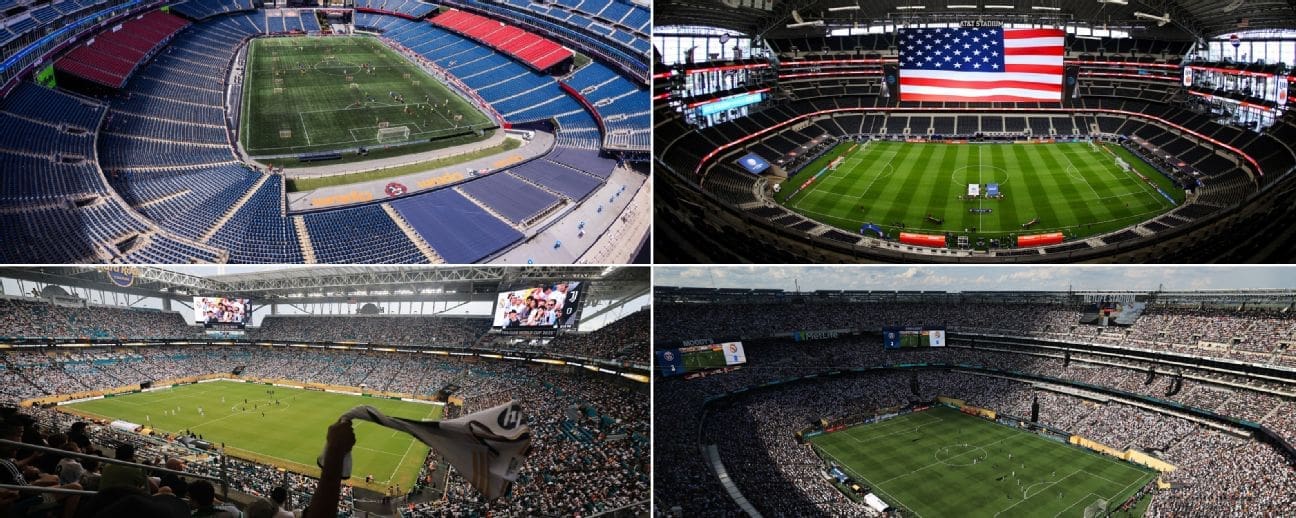
Large crowds and modern designs make many venues impressive, but size alone doesn’t make a stadium legendary.
What separates ordinary arenas from football cathedrals are the unforgettable matches, goals, and emotions shared within their walls.
The 1950 Maracanazo. Maradona’s Hand of God. Geoff Hurst’s hat-trick. These created history, not atmosphere.
This article ranks the best World Cup stadiums ever by three criteria: historical significance, attendance records, and lasting football legacy.
From the first World Cup in 1930 to the upcoming 2026 tournament, eight stadiums stand above the rest.
What Makes a World Cup Stadium Great
A stadium’s greatness comes from the stories attached to it. The ranking below follows three clear criteria:
- Key matches hosted. Venues that shaped tournaments or crowned champions.
- Attendance records. Stadiums where crowds reached unforgettable numbers.
- Iconic football moments. Events that remain part of global memory.
Size and construction style matter less than history created. A venue such as the Pontiac Silverdome was large, yet it hosted no defining event. True legends earn their place through moments remembered across generations.
The 8 Best World Cup Stadiums Ranked
| Stadium | Country | World Cups Hosted | Finals Hosted | Capacity (peak year) | Key Record or Fact |
| Estadio Azteca | Mexico | 1970, 1986, 2026 | 2 | 114,600 (1986) | Only stadium to host three World Cups; Pelé and Maradona both won here |
| Estadio do Maracanã | Brazil | 1950, 2014 | 2 | ~200,000 (1950 unofficial) | Largest crowd in football history, 173,850 official |
| Wembley Stadium (old) | England | 1966 | 1 | 98,600 | Geoff Hurst’s hat-trick gave England its only title |
| Rose Bowl | United States | 1994 | 1 | 94,194 | First World Cup final decided by penalties |
| Estadio Centenario | Uruguay | 1930 | 1 | ~93,000 | Site of the first World Cup final, FIFA Historical Monument of Football |
| FNB Stadium (Soccer City) | South Africa | 2010 | 1 | 84,490 | Africa’s largest capacity; birthplace of vuvuzela fame |
| Stade de France | France | 1998 | 1 | 80,698 | Zidane’s brace secured France’s first victory |
| Lusail Stadium | Qatar | 2022 | 1 | 88,966 | Hosted Messi’s historic 2022 win and Mbappé’s hat-trick |
#1) Estadio Azteca – The Stadium of Legends
No other stadium has hosted both Pelé’s and Maradona’s greatest moments. In 1970, more than 107,000 fans witnessed Brazil defeat Italy 4–1, ending with Carlos Alberto’s famous goal.
That same tournament featured the “Game of the Century,” the 4–3 semi-final between Italy and West Germany.
In 1986, Maradona scored two of football’s most replayed goals against England in the quarter-final: the Hand of God and the Goal of the Century.
Argentina went on to beat West Germany 3–2 in the final before 114,600 people.
Sitting 2,200 meters above sea level, Azteca’s altitude slowed play and tested stamina. After a €110 million renovation, it will host the opening match of the 2026 World Cup, becoming the first stadium to stage three tournaments. Data and historical records appear on FIFA’s official stadium page.
#2) Estadio do Maracanã – Home of the World’s Biggest Crowd
The Maracanã’s legend began on July 16, 1950, when 173,850 fans officially packed inside, nearly 200,000 by some estimates.
Brazil needed only a draw against Uruguay to win. Uruguay’s 2–1 victory created the term “Maracanazo,” meaning a national heartbreak.
That record crowd will never be broken because modern safety rules limit stadium capacity. In 2014, the Maracanã again hosted the final between Germany and Argentina and the 7–1 semi-final loss that stunned Brazil.
Today it seats about 78,000, but it still carries unmatched emotional weight. Attendance statistics are confirmed by Guinness World Records.
#3) Wembley Stadium (Old) – England’s Triumph
Wembley hosted England’s only World Cup title in 1966. A crowd of 98,600 watched England defeat West Germany 4–2.
Geoff Hurst became the first player to score a hat-trick in a World Cup final, including the famously debated third goal that continues to spark discussion.
The original twin-tower stadium was demolished in 2003 and replaced by the modern Wembley, but the legacy of 1966 remains attached to the old ground. Complete tournament archives are listed on Wikipedia’s World Cup finals venue record.
#4) Rose Bowl – Record Attendance in the United States
The Rose Bowl hosted the 1994 final between Brazil and Italy in front of 94,194 spectators.
The match ended 0–0 and was decided by penalties, with Roberto Baggio’s missed shot confirming Brazil’s win.
Across eight games played there, the Rose Bowl averaged 92,800 fans per match, setting a record that still stands.
It also hosted the 1999 Women’s World Cup final, linking two historic tournaments in one venue. This balance of attendance and legacy puts the Rose Bowl among the best World Cup stadiums ever.
#5) Estadio Centenario – Where Football’s World Stage Began
Constructed for the first World Cup, Montevideo’s Estadio Centenario hosted every major match of the 1930 tournament, including the final. Uruguay defeated Argentina 4–2 before 93,000 people.
The stadium opened only five days before the event due to weather delays, yet became an instant symbol of international football.
It remains active today and is officially declared by FIFA as the world’s only Historical Monument of Football. Updated historical details appear in FIFA’s archives.
#6) FNB Stadium – Africa’s Iconic “Calabash”
In Johannesburg, FNB Stadium, known as Soccer City during the 2010 World Cup, stands as a symbol of African culture. Its calabash-inspired design reflects traditional pottery.
During the opening match, Siphiwe Tshabalala scored a goal against Mexico that became the soundtrack of the vuvuzela era.
The final hosted 84,490 fans who saw Spain beat the Netherlands 1–0 for its first title. The stadium later expanded to 94,736 seats, making it Africa’s largest football arena.
#7) Stade de France – A Moment of National Pride
Opened for the 1998 World Cup, the Stade de France staged France’s first and only World Cup victory. In front of 80,698 fans, France defeated Brazil 3–0 with Zinedine Zidane scoring twice.
The stadium later hosted the Rugby World Cup final in 2007, building a reputation as France’s national stage for global events. Its continued use for major matches confirms its standing among football’s modern icons.
#8) Lusail Stadium – The Modern Masterpiece
Lusail in Qatar hosted the 2022 final, one of the most dramatic matches in tournament history.
Argentina defeated France 4–2 on penalties after a thrilling 3–3 draw. Kylian Mbappé scored a hat-trick and Lionel Messi lifted his long-awaited trophy.
With space for 88,966 spectators and advanced cooling systems, Lusail represents twenty-first century innovation.
The stadium still hosts global sports and entertainment events, keeping its connection to the World Cup alive.
Azteca’s 2026 Return and Its Evolving Legacy
In 2026, Estadio Azteca will open the World Cup again. After its renovation, capacity now stands at 87,523 with upgraded technology and renewed facilities.
This third hosting makes Azteca the only stadium ever to stage three tournaments.
For fans, stepping inside means walking on the same pitch where Pelé and Brazil ruled in 1970 and Maradona performed magic in 1986.
Its record and history confirm it as football’s most significant arena.
FAQs
What is the most famous World Cup stadium?
Estadio Azteca in Mexico is the world’s best-known venue for hosting three tournaments and moments by Pelé and Maradona.
Which stadium had the biggest crowd in World Cup history?
The Maracanã in Brazil recorded an official attendance of 173,850 during the 1950 final, the largest ever confirmed in football.
Which stadium is officially a FIFA Historical Monument?
Estadio Centenario in Uruguay is the only stadium recognized by FIFA as a Historical Monument of Football.
Why is Azteca considered the greatest stadium?
It hosted two finals, several legendary matches, and will set an unmatched record by welcoming its third World Cup in 2026.
Is Lusail Stadium still active after 2022?
Yes. It continues to host sports and cultural events and remains a centerpiece of Qatar’s Lusail City project.


