The FIFA World Cup is the biggest stage in football. Every four years, billions of fans watch their heroes chase glory. Some matches end quietly. But others become legends.
The most dramatic World Cup matches are more than just games. They are moments in history. They feature comeback goals, shocking upsets, and individual brilliance that no one ever forgets.
This article covers the greatest, most intense, and most unforgettable World Cup games ever played. Whether you are a lifelong fan or just getting into football, these matches will show you exactly why the World Cup is so special.
Key Matches at a Glance
| Match | Year | Stage | Score | Why It’s Dramatic |
| Italy vs West Germany | 1970 | Semifinal | 4-3 (AET) | Five goals in extra time |
| Argentina vs England | 1986 | Quarterfinal | 2-1 | Hand of God + Goal of the Century |
| West Germany vs France | 1982 | Semifinal | 3-3 (5-4 pens) | Brutal foul, four extra-time goals |
| Brazil vs Germany | 2014 | Semifinal | 1-7 | Five goals in 18 minutes |
| Argentina vs France | 2022 | Final | 3-3 (4-2 pens) | Hat-trick, two comebacks, penalties |
| England vs West Germany | 1966 | Final | 4-2 (AET) | England’s only World Cup title |
| Brazil vs Uruguay | 1950 | Final Group Stage | 1-2 | Home crowd stunned at Maracana |
Italy vs West Germany (1970): The Game of the Century
No match in World Cup history has earned a bigger nickname. The 1970 semifinal between Italy and West Germany is widely known as “The Game of the Century.”
It took place at the Azteca Stadium in Mexico City, at over 2,200 meters above sea level. The altitude made the physical demands nearly impossible.
Italy led 1-0 for most of the game and looked set to win with ease. Then, in the final minutes of regular time, Karl-Heinz Schnellinger scored a stunning equalizer for West Germany.
That goal sent the match into extra time, and from that moment, the football world witnessed something truly extraordinary.
Five goals were scored during extra time alone, which is still a record for any FIFA World Cup match. The lead changed hands multiple times in a span of just 30 minutes.
West Germany took the lead in the 94th minute, Italy hit back almost immediately, and the game kept swinging back and forth. It was impossible to predict what would happen next.
Italy’s Gianni Rivera scored the winning goal in the 111th minute to seal a 4-3 victory. The match was broadcast live on television across Europe, and viewers were left speechless.
Decades later, it remains the standard by which all dramatic World Cup games are measured.
Argentina vs England (1986): Two Goals, Two Legends
The 1986 quarterfinal between Argentina and England was never just a football match. It came just four years after the Falklands War between the two nations.
The political tension in the air made every moment feel heavier than usual.
Diego Maradona scored two of the most talked-about goals in football history in this single game. His first goal came from a deliberate handball that the referee failed to spot.
Maradona later said the goal was scored “a little with the head of Maradona and a little with the hand of God.” That line became one of the most famous quotes in sporting history.
His second goal came just minutes later and is considered by many the greatest individual goal ever scored.
Maradona picked up the ball in his own half and dribbled past five England players before slotting the ball into the net. FIFA later named it the “Goal of the Century” after fans voted in a worldwide poll.
Argentina won 2-1 and went on to win the World Cup. The match remains one of the most analyzed and discussed games ever played.
It is a perfect example of how football, history, and politics can collide on a single afternoon.
West Germany vs France (1982): Drama and Controversy
The 1982 World Cup semifinal between West Germany and France had everything a football fan could ask for.
It had brilliant goals, a shocking moment of violence, dramatic comebacks, and a penalty shootout. Many football historians consider it one of the greatest and most controversial matches ever played.
The match is most remembered for an incident involving West Germany goalkeeper Harald Schumacher.
He launched himself into French player Patrick Battiston and knocked him unconscious. Battiston suffered broken teeth and cracked ribs.
Remarkably, Schumacher received no punishment from the referee. The incident shocked the world and sparked a debate about player safety that lasted for years.
France seemed poised to win after leading in extra time, but West Germany kept fighting. The final score after 120 minutes was 3-3.
It then became one of the first major World Cup matches to be decided by a penalty shootout. West Germany won 5-4 on penalties and advanced to the final.
The match left French fans heartbroken and created one of the most passionate rivalries in international football.
It also helped push FIFA to reconsider the rules around goalkeeper challenges on outfield players. The game had a lasting impact on how the sport was played and regulated.
Brazil vs Germany (2014): The Mineirazo
Brazil hosting the 2014 World Cup was supposed to be a dream come true. The nation poured its heart into the tournament.
Reaching the semifinal at home, in front of their own fans, felt like destiny. What happened next stunned the entire world.
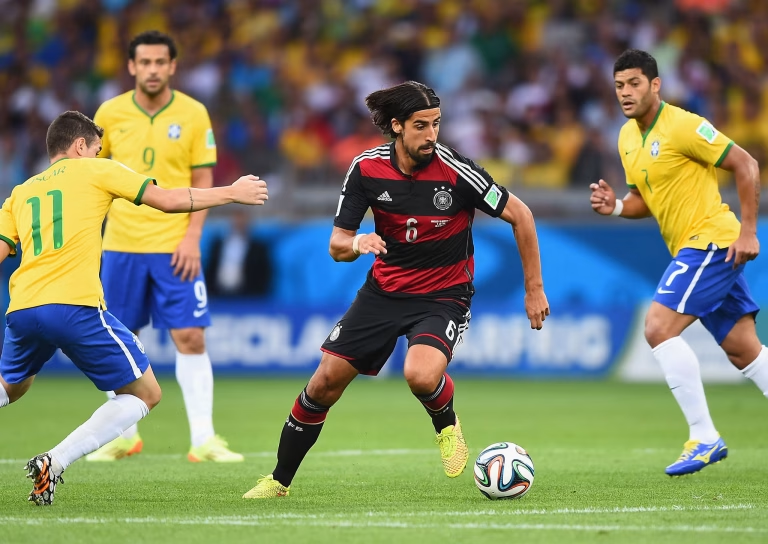
Germany scored five goals in just 18 minutes during the first half. Thomas Muller scored twice, Miroslav Klose became the all-time leading World Cup goalscorer, and Toni Kroos added two more in two minutes.
The Brazilian crowd sat in silence. Some fans were in tears before halftime.
The final score was 7-1. It was Brazil’s worst ever defeat at a World Cup and their heaviest loss in any competition in 94 years. Germany’s win was the largest margin of victory in a World Cup semifinal in history.
The match quickly earned the nickname “Mineirazo,” a reference to the stadium in Belo Horizonte and the equally painful 1950 loss known as the Maracanazo.+1
This game stands apart from most dramatic matches because it was not dramatic in a back-and-forth sense.
The drama came from shock, disbelief, and heartbreak. It proved that even the most celebrated footballing nations can fall apart completely under pressure.
Argentina vs France (2022): The Greatest Final Ever
The 2022 World Cup final in Qatar between Argentina and France is widely regarded as the most dramatic World Cup match ever played.
It had everything. Argentina were 2-0 up and cruising toward the trophy when France launched a stunning comeback.
Kylian Mbappe scored two goals in just 97 seconds to level the match at 2-2. Argentina then took the lead again through Lionel Messi in extra time.
Mbappe immediately hit back with a penalty to make it 3-3. The match had swung five times in its final 40 minutes.+1
Messi scored in the penalty shootout and goalkeeper Emiliano Martinez saved a crucial spot kick. Argentina won 4-2 on penalties.
Messi became the first player ever to score in every knockout round of a single World Cup tournament. He finally had the one trophy his career had always been missing.espn+1
France’s Mbappe scored a hat-trick in a World Cup final, a feat last achieved by Geoff Hurst in 1966. Yet his team still lost.
The match drew record television audiences around the world and has since been called the greatest football game ever played by fans and experts alike. You can relive key moments on the official FIFA match page.
England vs West Germany (1966): History at Wembley
England’s only World Cup title came in 1966 at Wembley Stadium against West Germany. It was a final full of tension, controversy, and late drama.
West Germany scored a last-minute equalizer to force extra time, just as England thought the trophy was theirs.
Geoff Hurst then scored one of the most debated goals in football history. His shot hit the crossbar and bounced down. The referee ruled that the ball had crossed the line.
West German players and fans argued it had not. The goal stood, and it remains a talking point to this day.
Hurst then scored again to complete a hat-trick and seal a 4-2 victory. He is still the only player to score a hat-trick in a World Cup final.
England celebrated wildly. The moment marked the peak of English football history, a moment that generations of fans have been waiting to see repeated ever since.
Brazil vs Uruguay (1950): The Maracanazo
Long before the Mineirazo, there was the Maracanazo. Brazil hosted the 1950 World Cup and needed only a draw in their final group stage match against Uruguay to win the title.
Nearly 200,000 fans packed the Maracana Stadium in Rio de Janeiro.
Brazil scored first and the crowd roared. Then Uruguay hit back with two goals and won 2-1. The stadium fell silent. People wept in the stands.
Brazilian goalkeeper Moacyr Barbosa was blamed by some fans for the rest of his life. The defeat became the most painful moment in Brazilian football history.
The match is a reminder that football can turn in an instant. No lead is ever truly safe, and no result is guaranteed.
The Maracanazo shaped the culture of Brazilian football and made the nation more determined than ever to one day conquer the world.
Why These Matches Still Matter
The most dramatic World Cup matches share something important. They are not just about final scores. They are about human emotion, national pride, and moments that transcend sport.
These games live on because they connect generations. A grandfather who watched Italy beat West Germany in 1970 can explain every goal to his grandchildren today.
A young fan who watched the 2022 final will talk about it for the rest of their life. That is the power of the World Cup.
The drama is also what makes the tournament unique. Unlike league football, there are no second chances. Every match is a knockout waiting to happen. One moment can make a player a hero or send a nation home in tears.
These stories also inspire the next generation. Young players grow up watching these games and dreaming of writing their own chapter. That cycle of inspiration is what keeps the World Cup the most watched sporting event on the planet.
FAQs
What is the most dramatic World Cup match ever played?
Most football fans and experts point to the 2022 World Cup final between Argentina and France as the most dramatic World Cup match ever. It featured a 2-0 lead, a stunning comeback, multiple lead changes in extra time, and a penalty shootout decided by the two best players of their generation.
What was the “Game of the Century” at the World Cup?
The 1970 World Cup semifinal between Italy and West Germany is known as the “Game of the Century.” Italy won 4-3 after extra time, with five of the seven goals scored in the extra 30 minutes alone. It remains the record for most goals in extra time in a World Cup match.
What happened in the Germany vs Brazil 7-1 game?
Germany defeated Brazil 7-1 in the 2014 World Cup semifinal. Germany scored five goals in just 18 minutes in the first half, stunning Brazil on home soil. The result became known as the Mineirazo and is still remembered as one of the most shocking results in football history.
Why is Argentina vs England 1986 so famous?
The 1986 quarterfinal is famous because Diego Maradona scored two contrasting and iconic goals in the same match. The first, known as the “Hand of God,” was controversial. The second, called the “Goal of the Century,” is widely considered the greatest individual goal ever scored at a World Cup. These most dramatic World Cup matches often come down to one unforgettable performance.
Which World Cup final went to a penalty shootout?
Several World Cup finals have gone to penalties, including the 1994 final between Brazil and Italy, and the 2022 final between Argentina and France. The 2022 final is widely seen as the greatest, with both teams level at 3-3 after extra time before Argentina won the shootout 4-2.