Few sporting events on Earth carry the weight that the FIFA World Cup does. Every four years, nations stop. Families gather. Strangers cry together in the streets.
Football has always been more than a sport. It is identity, hope, and belonging compressed into 90 minutes. The most emotional FIFA World Cup games are proof of that. They are not just about goals or results. They are about human beings at their absolute limit.
This article covers the games and moments that hit the deepest. You will find stories of heartbreak, joy, shock, and everything in between.
A Quick Look at the Matches Covered
| Year | Match | The Emotional Core |
| 1950 | Uruguay vs Brazil | A nation silenced on home soil |
| 1990 | England vs West Germany | Gazza’s tears on live television |
| 1994 | Italy vs Brazil (Final) | Baggio’s missed penalty in the shootout |
| 2006 | Italy vs Germany (Semi-Final) | German fans weeping in the 119th minute |
| 2010 | Ghana vs Uruguay | Gyan’s crossbar hit and Africa’s broken dream |
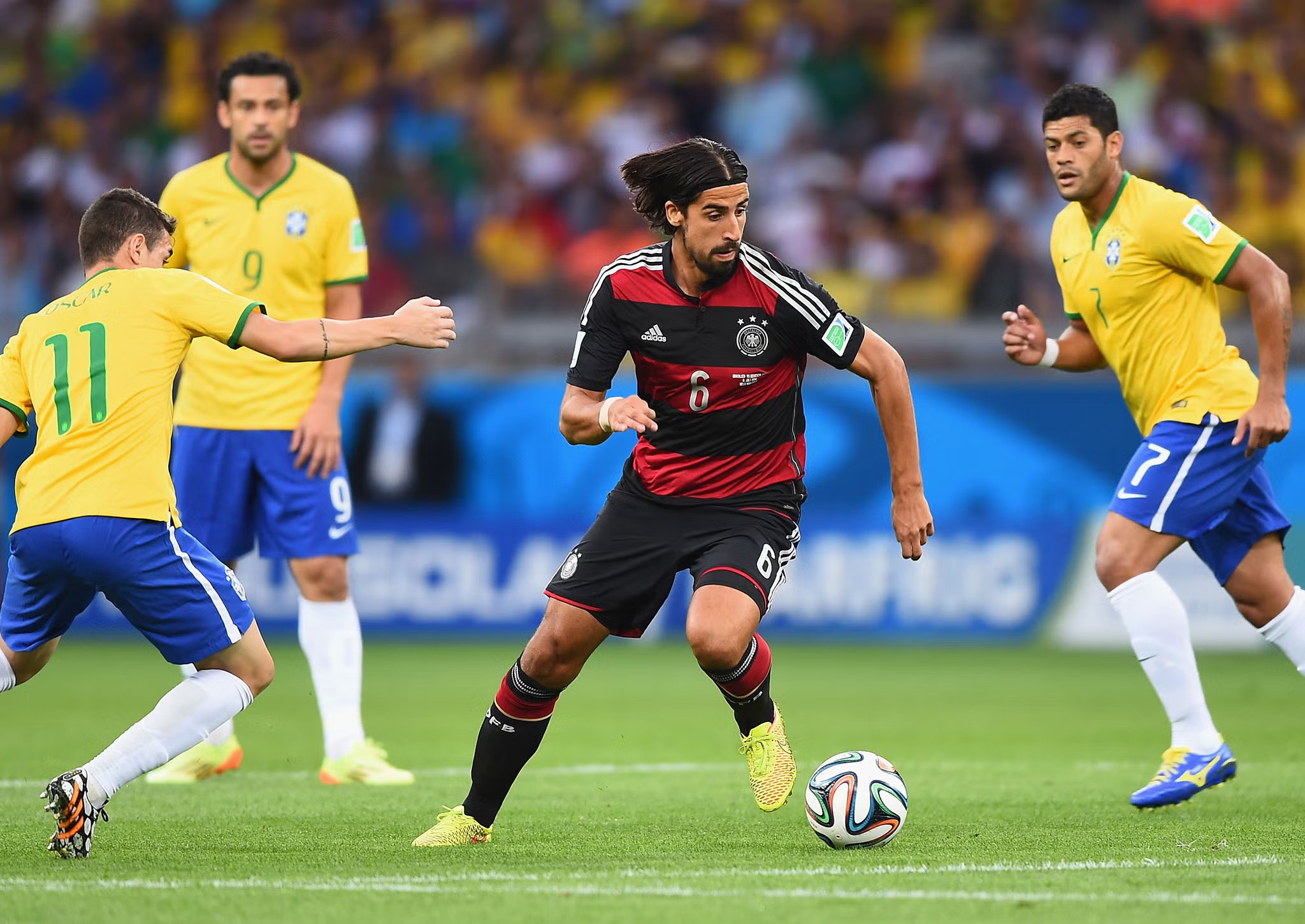
| 2014 | Brazil vs Germany | Brazilians crying at halftime |
| 2022 | Argentina vs France (Final) | Messi’s redemption at 35 |
The 1950 Maracanazo: Brazil’s Deepest Wound
Uruguay’s win over Brazil in 1950 is still considered one of football’s most painful moments. Brazil were the hosts.
The newspapers had already printed “Champions of the World” before the match even started. Around 200,000 fans packed into the Maracana expecting a celebration.
What happened instead was a nightmare. Uruguay came from behind to win 2-1 and claim their second World Cup title.
The crowd fell completely silent. Some fans reportedly fainted. Others wept openly in the stands.
This match is called the “Maracanazo,” which roughly means “the blow at the Maracana.” It scarred Brazilian football for generations.
Players and fans alike spoke about it for decades as an open wound that never fully healed.
The pain of that day shaped how Brazil approached every World Cup that followed. The pressure to win on home soil became part of Brazilian football culture.
Losing in front of your own people, especially in a match you were expected to win easily, is a weight very few sports moments can match.
1982: Marco Tardelli’s Tears of Pure Joy
Joy can be just as emotional as heartbreak. Marco Tardelli proved that in the 1982 World Cup final when Italy faced West Germany in Spain.
After scoring Italy’s second goal, he ran toward the touchline with his fists raised, screaming, and tears streaming down his face.
That image became one of the most iconic in all of football history. Tardelli later explained that in that moment, he thought about being a young kid kicking a ball and dreaming of exactly this. The goal and the raw joy behind it represent everything a player works for.
Italy went on to win the final 3-1, claiming their third World Cup title. But what people remember most is not the trophy.
It is the face of a man crying with happiness after scoring on the biggest stage in the world.
Tardelli’s celebration showed that the World Cup is as much about personal stories as it is about national glory.
Millions of people watching around the globe understood exactly what he was feeling, even without speaking the same language.
1990: Gazza’s Tears Break a Nation’s Heart
England midfielder Paul Gascoigne received a yellow card against West Germany in the 1990 semi-final.
It meant that if England made it to the final, he would miss it. When he realized what had happened, his bottom lip trembled on live television. The entire nation broke with him.
Gascoigne was not just a footballer to England fans. He was electric, unpredictable, and completely one of a kind at Italia 90.
Watching him cry while still fighting in a World Cup semi-final felt impossibly unfair. It is still described as one of the most powerful emotional moments in English football history.
England went on to lose that semi-final 4-3 on penalties. Gascoigne was not selected to take one of the first five kicks. When the team was eliminated, he cried again.
The image of “Gazza crying” became a symbol of what the World Cup does to people.
That moment helped a whole new generation fall in love with football. If a player that talented could feel that much pain over a yellow card, it told the world that these players genuinely care. More than fans ever realized.
1994: Roberto Baggio’s Haunting Penalty Miss
No moment in World Cup history captures individual heartbreak quite like Roberto Baggio’s penalty miss in the 1994 final.
Italy faced Brazil at the Rose Bowl in Pasadena. After 120 goalless minutes, the title came down to a shootout.
Brazil led 3-2 in the shootout. Baggio stepped up last. If he missed, Italy were done. He sent the ball sailing over the crossbar.
He stood there alone, head down, staring at the grass, while Brazil’s players erupted around him.
Years later, Baggio described the moment in terms that are hard to read. He said he wanted to die at that instant.
The emotional weight he carried from that penalty follows him to this day, decades after the final whistle.
What makes this moment so deeply emotional is the full context of what led to it. Baggio had carried Italy almost single-handedly to that final, scoring five goals in the knockout rounds. He gave everything the tournament asked of him.
2006: Italy vs Germany in the Night of Dortmund
The 2006 semi-final between Italy and Germany was played in Dortmund in front of 65,000 fans, most of them German.
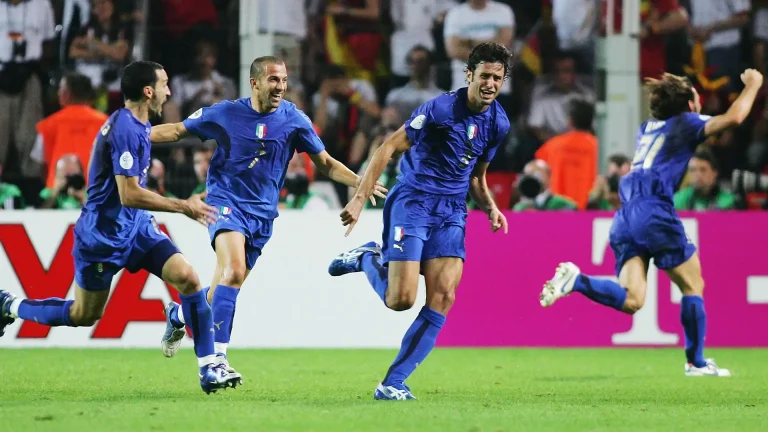
For 118 minutes, neither team scored. The tension was unbearable. Then Fabio Grosso scored in the 119th minute with a left-footed finish that silenced the entire stadium.
The cameras caught German fans in tears. Some had their hands over their heads. Others were frozen in complete shock. Alessandro Del Piero added a second goal moments later to finish the job. Germany, on their home soil, could not reach the final in Berlin.
Italy went on to win the World Cup. But this semi-final is remembered as much for the pain it caused in Germany as for the brilliance of Italy. Watching thousands of people cry in real time inside a football stadium is hard to forget.
Germany did go on to win the World Cup in 2014. But the sting of 2006 lingered for years among supporters who had felt so close to glory at home.
2010: Asamoah Gyan and Africa’s Broken Dream
The 2010 quarter-final between Ghana and Uruguay was not just a football match. It was a chance for an African team to reach the World Cup semi-final for the very first time. The whole continent was watching.
In the final seconds of extra time, Luis Suarez deliberately handled the ball on the goal line to deny a certain goal. He was sent off immediately. Ghana were awarded a penalty. Asamoah Gyan stepped up with the chance to make history. He hit the crossbar.
Ghana lost on penalties. Gyan later admitted that he cried all night after the match. He said the miss haunted him for years. He also revealed that he heard voices telling him not to shoot just before he took the kick.
The emotional weight of that moment was not just personal. It belonged to an entire continent. Despite the pain, Gyan showed remarkable courage by stepping up first in the shootout itself and scoring.
His character was always bigger than one missed kick. It just did not feel that way at the time.
2014: The Mineirazo and James Rodriguez’s Exit
The 2014 World Cup in Brazil produced two of the most emotionally charged moments of the modern era. Both came just days apart and both involved tears that millions of people will never forget.
First came the semi-final destruction of Brazil by Germany. The score finished 7-1. Germany scored five goals in the first 29 minutes. The host nation collapsed so completely that Brazilian fans in the Mineiro Stadium were crying well before halftime.
The “Mineirazo,” as it became known, was a national trauma broadcast live to the entire world. It was painful to watch even for neutral supporters who had no stake in the result.
Then came Colombia’s quarter-final exit against Brazil. James Rodriguez had been the most exciting player of the tournament, scoring six spectacular goals.
When Colombia lost, James wept openly on the pitch. Brazilian defenders David Luiz and Dani Alves walked over to comfort him, and the image was shared around the world.
James was still the tournament’s top scorer. He would go on to win the Golden Boot. But none of that felt like comfort in that moment.
His tears were not just about losing. They were about a dream ending far sooner than he had hoped.
2022: Argentina vs France, the Greatest Final Ever
The 2022 FIFA World Cup final between Argentina and France is widely considered the greatest match in World Cup history. More importantly, it was emotional on every possible level.
Argentina led 2-0 heading into the final stretch, with goals from Messi and Angel Di Maria. The trophy seemed wrapped up.
Then Kylian Mbappe scored twice in 97 seconds to level the game. In extra time, Messi scored again to make it 3-2. Mbappe scored again from the spot to force a penalty shootout. Argentina eventually won 4-2 on penalties.
For Messi, it was redemption after a career full of near-misses. He had carried Argentina to the final multiple times and always fallen short.
Watching him lift the trophy at 35 years old, exhausted and in tears, brought an emotional response from millions of fans who had followed his entire journey.
The range of emotions in that single match was extraordinary. Here is what made it so unique:
- Argentina celebrated a dominant first half performance, then watched the game completely fall apart
- Mbappe became the first player since Geoff Hurst in 1966 to score a hat-trick in a World Cup final, yet still finished on the losing side
- French fans went from grief to hope to despair all within 30 minutes of extra time
- Messi’s face when the final whistle blew told the story of an entire career in a single expression
The 2022 final had joy and heartbreak living side by side in the same stadium at the same time. No match before it or since has come close to matching that emotional range.
FAQs
What is considered the most emotional FIFA World Cup game ever?
Many football historians point to the 2022 World Cup final between Argentina and France as the most emotional FIFA World Cup game in modern history. It featured multiple lead changes, a hat-trick in a losing final, and Messi’s long-awaited redemption moment.
Why was Gazza’s crying moment so significant at the 1990 World Cup?
Paul Gascoigne’s tears during the 1990 semi-final against West Germany became one of the most iconic images in English football history. His visible emotion on live television helped a new generation connect deeply with the World Cup and understand how much the tournament means to the players themselves.
What happened when Roberto Baggio missed his penalty in 1994?
Roberto Baggio missed the decisive penalty in the 1994 World Cup final, sending the ball over the crossbar and handing Brazil the title in the shootout. Baggio later described the moment as one of the most crushing of his life, and he has said the memory still haunts him decades later.
How did Brazil’s 7-1 loss to Germany in 2014 become so emotional?
Brazil were the hosts of the 2014 World Cup and heavy favorites to win the tournament on home soil. When Germany scored five goals in the opening 29 minutes of their semi-final, the emotional collapse in the stadium was instant. Brazilian fans were visibly crying in the stands well before halftime, making it one of the most painful moments in football history.
Which World Cup moment was most emotional for African football fans?
Asamoah Gyan’s penalty miss against Uruguay in the 2010 quarter-final is considered the most emotionally devastating moment for African football fans. Ghana were seconds away from becoming the first African nation to reach a World Cup semi-final before the miss ended that dream, leaving Gyan and the entire continent heartbroken.