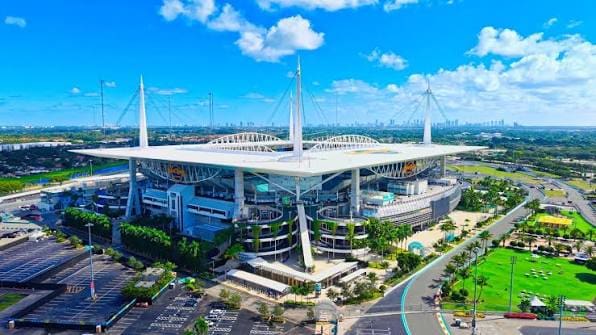
Some stadiums host matches. A handful become the match.
The most iconic World Cup venues are defined by what happened inside them: Diego Maradona beating England almost single‑handedly, 200,000 people stunned into silence in Rio, Uruguay lifting the first-ever trophy in a ground that was barely finished.
Since 1930, hundreds of World Cup venues have come and gone, but only a few stadiums now act as fixed points in football history.
This guide focuses on seven World Cup venues whose records, finals, and defining moments justify the label “iconic” — plus one final section that settles which ground has hosted the most World Cup games.
Iconic World Cup Venues Overview
From the Maracanã to Estadio Azteca, these are the most iconic World Cup venues, ranked by history, records, and the matches that made them legendary.
| Venue | Country | World Cup Years | Finals Hosted | Peak Capacity (WC era) | Defining Moment |
| Estadio Azteca | Mexico | 1970, 1986, 2026 | 2 | 114,600 | Maradona vs England, Hand of God and Goal of the Century |
| Maracanã | Brazil | 1950, 2014 | 2 | ~200,000 | Maracanazo, Brazil 1–2 Uruguay |
| Estadio Centenario | Uruguay | 1930 | 1 | 90,000 | First ever World Cup final |
| Wembley Stadium | England | 1966 | 1 | ~97,000 | England’s only World Cup win |
| Rose Bowl | USA | 1994 | 1 | 94,194 | First World Cup final decided on penalties |
| Stade de France | France | 1998 | 1 | 80,000 | France’s first World Cup title |
| Olympiastadion Munich | Germany | 1974 | 1 | 86,000 | Total Football vs West Germany |
What Makes a World Cup Venue Iconic
Some stadiums are big. Only a few become part of football history. Iconic World Cup venues earn that status in three clear ways.
First, they set records. This might be the most World Cup matches hosted, the highest attendance, or a rare record like hosting multiple finals. Second, they stage defining matches.
These are games that fans still name decades later, such as the Maracanazo or the quarter final where Maradona scored his most famous goals. Third, some venues matter because of their design or cultural meaning.
These are stadiums that came to stand for a country or an era, not just a team.
When you look at the most iconic World Cup venues, you see all three patterns. Estadio Azteca and Maracanã combine records and defining matches. Estadio Centenario and Wembley link football history with national identity.
Olympiastadion Munich and Stade de France carry strong architectural and political stories along with big games. The sections that follow use this lens to show why these seven grounds sit at the top of any World Cup venue list.
#1) Estadio Azteca, Mexico City
Estadio Azteca in Mexico City is the only stadium to host two World Cup finals and matches at three different World Cups.
It first appeared at the 1970 World Cup, returned in 1986, and will be back again in 2026.
This separate tournament record already sets it apart from other World Cup venues. It is also one of only two venues to host multiple World Cup finals, the other being the Maracanã.
The most famous match at Estadio Azteca is the 1986 quarter final between Argentina and England. In that game, Diego Maradona scored both the Hand of God goal and the Goal of the Century.
The first was punched into the net, but the referee allowed it. The second was a long dribble from his own half, past several players, before he scored.
These two moments in one game made Estadio Azteca part of global football memory.
Azteca’s World Cup story also includes the 1970 final. Brazil beat Italy 4–1 and Pelé won his third World Cup there.
That match is often described as the peak of the first Brazilian golden team, and it fixed Azteca as a natural stage for the very best sides.
In 1986, the stadium then hosted the final where Argentina beat West Germany 3–2 and Maradona lifted the trophy.
This gave Azteca a rare double: two different champions, Pelé and Maradona, celebrated World Cup wins in the same ground.
There is also a physical factor that makes Estadio Azteca unique. It sits at around 2,240 metres above sea level.
This high altitude means thinner air and lower oxygen for players. Teams needed different fitness plans and tactical approaches to cope with the conditions.
That helped shape how both the 1970 and 1986 tournaments were played in Mexico. Today, after renovations, the stadium’s capacity is about 87,500.
As the only venue to feature in three World Cups, it is often cited as the first answer when people ask about the most iconic World Cup venues.
#2) Maracanã, Rio de Janeiro
The Maracanã in Rio de Janeiro is tied to the most famous crowd figure in football history. At the 1950 World Cup, the decisive match between Brazil and Uruguay drew an official paid attendance of 199,854.
Some estimates suggest the true number in the stadium was even higher. No other football match has matched that figure, which gives the Maracanã a record that still stands.
The result of that game is known as the Maracanazo. Brazil needed only a draw to win the World Cup. Uruguay came from behind to win 2–1. The loss on home soil shocked Brazil and turned the stadium’s name into a word that means more than just a place.
The Maracanazo is still called one of the worst sporting moments in the country’s history. It also means the stadium itself is linked to both the highest point of attention and one of the lowest emotional moments in World Cup history.
The Maracanã returned to the centre of world football in 2014. After a major rebuild, with the capacity reduced to around 78,800 for safety and comfort, it hosted the World Cup final again.
This time Germany beat Argentina 1–0 after extra time, with Mario Götze scoring the only goal. That made the Maracanã, along with Estadio Azteca, one of only two stadiums to host two World Cup finals. Few venues can match this combination of history, records, and recent use.
As a World Cup venue, the Maracanã stands at the crossroads of record attendance, national story, and repeated use on the biggest stage.
Its huge first form and its modern rebuilt form show how stadiums evolve while the history attached to them remains.
When people think about World Cup venues with the strongest emotional weight, the Maracanã is usually near the top of the list.
#3) Estadio Centenario, Montevideo
Estadio Centenario in Montevideo is where the World Cup began. It was built for the first FIFA World Cup in 1930 and was planned as the main venue from the start.
Bad weather delayed the work, so the opening matches took place at smaller grounds in the city. When Centenario was ready, it took over as the key stadium and hosted the main games.
The first World Cup final was played there. Uruguay beat Argentina 4–2 in front of a crowd recorded at 68,346, though the stadium’s peak capacity in that era is usually listed as about 90,000.
That match created the idea of the World Cup final as a unique global event. It also set the pattern of the host nation winning the first tournament.
For that reason, when people ask which country was the first to win the FIFA World Cup, the answer is Uruguay, and Estadio Centenario is the ground where that happened.
The stadium was built largely in reinforced concrete, which was notable for such a large project in Latin America at the time.
Its design included a tall tower and steep stands that wrapped around the pitch.
Over time, it came to represent both Uruguayan football identity and the birth of the World Cup as a whole.
The link between Estadio Centenario and the first World Cup final is one of the strongest stadium and event pairs in football history.
FIFA later named Estadio Centenario a Historical Monument of World Football. It is the only stadium to receive that exact title.
Today its capacity is around 60,000 and it still hosts Uruguay national team matches. This means the first World Cup venue is not just a museum piece but a living stadium that still stages international games.
#4) Wembley Stadium, London
Wembley Stadium in London is known as the home of England’s only World Cup title. The original stadium opened in 1923 and stood until 2003.
Its key World Cup moment is the 1966 final, when England beat West Germany 4–2 after extra time.
The official attendance was just under 97,000, filling the ground for the biggest match England has ever hosted.
The game produced several enduring records and stories. Geoff Hurst scored a hat trick, the only time a player has scored three goals in a World Cup final.
His second goal is the subject of one of football’s longest debates.
The ball hit the crossbar and bounced down near the goal line. The referee, after consulting his linesman, decided it had crossed the line. Later video and studies still do not fully settle the question.
Wembley’s twin towers made it an easy stadium to recognise and helped fix it in the mind as a symbol of football in England.
Over the decades, it hosted not just World Cup matches, but also major European and domestic finals.
Pelé once called Wembley the “cathedral” and “heart” of football, which shows how even non English players saw its role.
The old stadium was demolished and replaced by the new Wembley, which opened in 2007 with a capacity of 90,000 and a large arch as its main visual feature.
While the new ground has not yet hosted a World Cup, it carries the same name and site. In World Cup terms, though, Wembley’s status comes almost entirely from the 1966 tournament and that single final.
#5) Rose Bowl, Pasadena
The Rose Bowl in Pasadena, California, is one of the few non football specific stadiums to gain a strong place in World Cup history. Built in 1922, it normally hosts American football and other events.
For the 1994 World Cup in the United States, it was adapted for football and given a capacity of 94,194. That made it the largest stadium of that World Cup.
The 1994 World Cup final took place at the Rose Bowl. Brazil and Italy drew 0–0 after 120 minutes. Brazil then won 3–2 in a penalty shootout.
This was the first World Cup final ever decided on penalties. It also gave Brazil their fourth world title. The match is not remembered for open play drama, but for the tension and the way the title was decided.
The Rose Bowl also hosted the 1999 Women’s World Cup final. The United States beat China on penalties after another 0–0 draw in front of 90,185 fans.
That game set a record for attendance at a women’s football match at the time and produced one of the most famous celebration photos in women’s sport.
These two finals, five years apart, give the Rose Bowl a special dual role in World Cup history.
Today the stadium’s capacity is a bit lower, at about 88,500. It continues to host college football and other large events.
While it has not hosted another men’s World Cup, its 1994 and 1999 finals ensure that it appears in any list of important World Cup venues, especially when you focus on matches decided on penalties and record crowds in North America.
#6) Stade de France, Saint Denis
Stade de France is the national stadium of France and was built for the 1998 World Cup. Located in Saint Denis, just north of Paris, it has a capacity of about 80,000.
Unlike older grounds that were adapted for the World Cup, this stadium was planned from the start to host the biggest games of the tournament.
Its defining match is the 1998 World Cup final. France beat Brazil 3–0, with Zinedine Zidane scoring two goals from corners in the first half.
This win gave France their first World Cup title and marked a major moment in the country’s sporting and social history.
The match also fixed Stade de France as the new centre of French football, replacing older venues that had served in that role.
The stadium features a modular lower tier. Around 25,000 seats can be moved to change the configuration for football, rugby, or athletics.
This flexible design was one of the key technical talking points when the stadium opened. Since then, it has hosted many major events, including the 2007 Rugby World Cup final and European finals.
For World Cup venues, Stade de France stands out because it combines a clear national story, a modern design, and a decisive final.
It is not the oldest or biggest stadium on this list, but the 1998 win and its continued use for major matches keep it central to any discussion of iconic World Cup venues in Europe.
#7) Olympiastadion Munich
Olympiastadion in Munich was built for the 1972 Summer Olympics and then used for the 1974 World Cup. During that tournament, it held around 80,000 to 86,000 spectators.
It hosted the 1974 World Cup final, one of the most analysed matches in football history. In that game, West Germany beat the Netherlands 2–1 after coming from behind.
The Dutch side, led by Johan Cruyff, played a style known as Total Football. Players would swap positions and press high up the pitch. Many people see this as one of the most important tactical developments in football.
The fact that this team lost the final to West Germany in Munich has made the stadium a symbol of the clash between new ideas and more traditional power.
The stadium is also known for its striking roof. A light, transparent canopy covers much of the stands and was a major engineering achievement in the early 1970s.
It gave the stadium an open, modern look with the nearby city and park visible. Many design and architecture courses still study this roof as an example of how to use new materials in large sports venues.
Politically, Olympiastadion was meant to represent a new, democratic West Germany. It was part of an effort to show a different image than the one linked to the 1936 Olympics in Berlin.
As a result, the stadium carries both sporting and cultural meaning. Today its capacity is reduced to about 69,000, and it is used less often for top level football.
Its World Cup legacy, however, remains tied to the 1974 final and the story of Total Football.
Which World Cup Venue Hosted the Most Matches
Estadio Azteca holds the record for the most World Cup matches hosted by a single stadium. Across the 1970 and 1986 tournaments it hosted 19 games.
This total includes group matches, knockout games, and two finals. No other World Cup venue has reached that number.
Maracanã is second in this category. Across the 1950 and 2014 World Cups it has hosted around 15 matches.
This again includes both finals and several key games. As the World Cup expands and moves to larger joint host formats, it is likely that Estadio Azteca will extend its lead when it hosts matches again in 2026.
FAQs
What was the first country to win the FIFA World Cup
The first country to win the FIFA World Cup was Uruguay. They won the 1930 final 4–2 against Argentina at Estadio Centenario in Montevideo, which was built for that tournament.
Which stadium has hosted the most World Cup finals
Two stadiums share the record for hosting the most World Cup finals. Estadio Azteca in Mexico City and the Maracanã in Rio de Janeiro have each hosted two World Cup finals.
Which World Cup venue had the highest attendance ever
The Maracanã in Rio de Janeiro holds the record for the highest reported crowd at a World Cup match. The 1950 match between Brazil and Uruguay had an official paid attendance of 199,854 spectators.
Where was the Hand of God goal scored
The Hand of God goal was scored at Estadio Azteca in Mexico City. Diego Maradona scored it for Argentina against England in the 1986 World Cup quarter final, in the same match as his Goal of the Century.
Why is Estadio Azteca often called the most iconic World Cup venue
Estadio Azteca is often called the most iconic World Cup venue because it has hosted matches at three World Cups and two finals, and it holds the record for most World Cup games. It also staged some of the most famous moments in World Cup history, including Pelé’s 1970 title and Maradona’s 1986 goals.