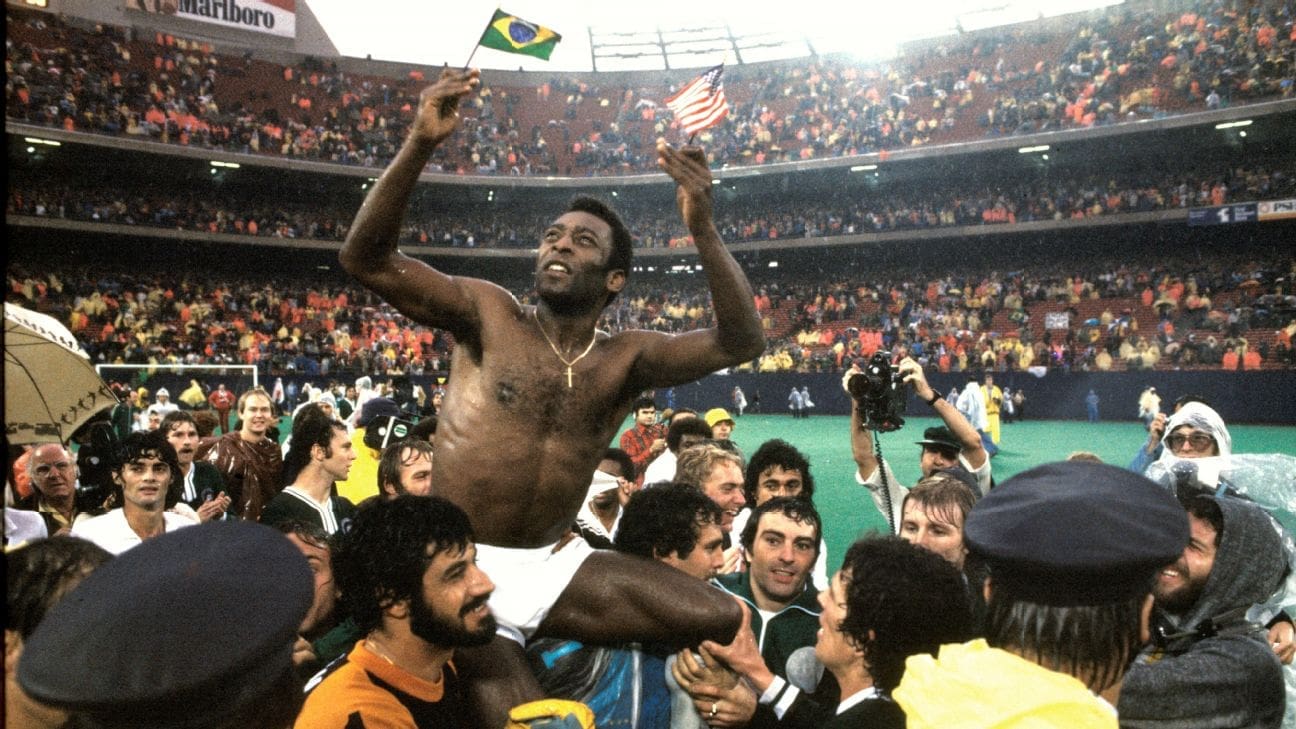
Pelé stands alone in football history. He’s the only player to win three World Cup titles, achieving this across 1958, 1962, and 1970 with Brazil.
At just 17 years old, he became the youngest World Cup winner in Sweden in 1958.
His journey spans three distinct chapters: a teenage phenom bursting onto the global stage, an injured star watching his team defend their crown, and a veteran master orchestrating what many call the greatest World Cup performance ever in 1970.
No player has matched this achievement in the 50+ years since, and the way modern football works, no one likely ever will.
You’ll learn how each tournament unfolded, the records that still stand today, and why Pelé’s World Cup dominance changed football forever.
1958 Sweden: Becoming the Youngest World Cup Winner at 17
Brazil came to Sweden carrying the weight of the 1950 Maracanazo, when they lost the World Cup final at home to Uruguay. Eight years later, they finally had their chance at redemption.
Pelé almost didn’t play. A knee injury kept him out of Brazil’s first two matches, a 3-0 win over Austria and a goalless draw with England. When he returned for the third group match against the Soviet Union, everything changed.
He set up Vavá for Brazil’s second goal in a 2-0 victory, and the youngest World Cup journey had begun.
The quarterfinal against Wales made history. Pelé scored the only goal of the match at 17 years and 239 days old, becoming the youngest World Cup scorer ever.
That record stood until 1982, and he remains the youngest player to score before turning 18.
But the semifinal against France showed what this teenager could really do. He scored a hat-trick in a 5-2 victory, leaving French defenders stunned at their inability to contain someone so young.
At 17 years and 244 days, he became the youngest player to score a hat-trick at a World Cup, a record that still stands.
The final against Sweden on June 29, 1958, cemented everything. Pelé scored twice in Brazil’s 5-2 victory, including a goal that’s still talked about today.
He flicked the ball over a defender’s head, let it drop, then volleyed it into the corner of the net. Swedish defender Sigvard Parling later said, “When Pelé scored the fifth goal in that final, I have to be honest and say I felt like applauding.”
At 17 years and 249 days, Pelé became the youngest player to score in a World Cup final. When the match ended, he collapsed on the field from exhaustion and emotion.
His teammate Gilmar told him, “Cry, my boy. It will do you good.” The King of Sweden came down from the stands to shake his hand.
Pelé finished the 1958 tournament with these key achievements:
- 6 goals in 4 matches played
- Youngest World Cup winner at 17 years 249 days
- Youngest World Cup scorer at 17 years 239 days
- Youngest hat-trick scorer at 17 years 244 days
- Youngest final scorer at 17 years 249 days
- Brazil’s first World Cup title
More importantly, the 1958 World Cup was the first to be broadcast globally on television, making Pelé the first black global sporting superstar at a time when the civil rights movement was gaining momentum worldwide.
1962 Chile: The Injury That Tested Brazil’s Depth
Pelé arrived in Chile as the reigning world champion and biggest star in football. European clubs had tried desperately to sign him after 1958, but the Brazilian government declared him a national treasure to keep him home.
He started strong. In the opening match against Mexico, Pelé scored one goal and assisted another in a 2-0 victory.
But in the second group match against Czechoslovakia, he pulled a muscle in his groin attempting a long-range shot. He tried to play through it but couldn’t continue.
Pelé spent the rest of the tournament watching from the sidelines while Garrincha, the other Brazilian hero of that era, carried the team to their second consecutive title.
Brazil became only the second nation ever to win back-to-back World Cups, joining Italy (1934, 1938).
The victory was bittersweet for Pelé. He’d won his second World Cup at 21, becoming the youngest player to win two World Cups, but he couldn’t contribute to the triumph.
Still, it showed Brazil’s incredible depth and proved they were more than a one-man team.
1966 England: The Tournament That Almost Ended His World Cup Career
Pelé came to England seeking a third consecutive title. What he got instead was brutal.
Bulgarian and Portuguese defenders targeted him with physical tackles that would draw immediate red cards today. The referees allowed the rough play to continue.
Pelé was injured again, and Brazil was eliminated in the group stage for the first time ever.
Frustrated and hurt, Pelé vowed never to play in another World Cup. He meant it.
For the next three years, he refused national team call-ups, focusing on his club career with Santos.
This context makes what happened next even more remarkable.
1970 Mexico: The Perfect Farewell and Final Triumph
Pelé changed his mind in 1969. At 29, he agreed to represent Brazil one more time.
He was at the peak of his powers, and the 1970 World Cup would be the first broadcast in color television worldwide.
Brazil’s squad was stacked. Alongside Pelé, they had Jairzinho, Rivelino, Gérson, Tostão, and captain Carlos Alberto.
Many consider this the greatest national team ever assembled.
The tournament became Pelé’s masterpiece. Against Czechoslovakia in the opener, he gave Brazil a 2-1 lead by controlling a 50-yard pass from Gérson with his chest before scoring.
In the same match, he attempted an audacious shot from the halfway line that nearly went in, with goalkeeper Ivo Viktor barely tipping it over the bar.
Against England, Pelé produced what many call the greatest save in World Cup history, though it was actually Gordon Banks who made it. Pelé’s downward header from close range seemed destined for the goal, but Banks somehow dove across and pushed it over.
Pelé thought it was in. So did everyone watching.
Brazil won 1-0, with Pelé assisting Jairzinho for the only goal.
Against Romania, Pelé scored twice. Against Peru in the quarterfinals, he assisted Tostão.
Against Uruguay in the semifinals, he set up Rivellino and produced another famous moment when he dummied past goalkeeper Ladislao Mazurkiewicz, running around him without touching the ball. The shot narrowly missed, but the audacity left everyone stunned.
The final against Italy on June 21, 1970, brought everything together. Pelé opened the scoring in the 18th minute, heading in a cross from Rivelino.
Italian defender Tarcisio Burgnich, who marked him that day, later said: “I told myself before the game, he’s made of skin and bones just like everyone else, but I was wrong.”
Brazil won 4-1. Pelé’s final contribution came in the 86th minute when he orchestrated what’s considered one of the greatest goals in World Cup history.
After a flowing move involving seven Brazilian players, Pelé received the ball in Italy’s penalty area with defenders surrounding him. Without looking, he rolled a pass to his right where Carlos Alberto was sprinting forward.
Carlos Alberto hammered it into the corner.
Pelé’s 1970 World Cup achievements included:
- Golden Ball as tournament’s best player
- 4 goals scored across 6 matches
- Directly involved in 53% of Brazil’s goals
- Assists on crucial goals in knockout rounds
- Brazil’s third World Cup title
- Permanent possession of Jules Rimet Trophy for Brazil
The 1970 team’s style of play influenced how football is played worldwide. The color television broadcast cemented Pelé’s visual legacy for generations who would never see him play live.
Record-Breaking Achievements Across Four Tournaments
Pelé played in four World Cups and set records that define greatness:
| Record | Age/Details | Tournament | Still Standing? |
| Youngest World Cup winner | 17 years 249 days | 1958 Sweden | Yes |
| Youngest World Cup scorer | 17 years 239 days | 1958 Sweden | Yes (youngest under 18) |
| Youngest hat-trick scorer | 17 years 244 days | 1958 Sweden | Yes |
| Youngest final scorer | 17 years 249 days | 1958 Sweden | Yes |
| Only player to win three World Cups | 1958, 1962, 1970 | All three | Still unique |
| 12 World Cup goals | 6 in 1958, 1 in 1962, 1 in 1966, 4 in 1970 | Four tournaments | Tied-6th with Mbappé |
| Scored in 4 World Cups | 1958-1970 | Four tournaments | 1 of 5 players ever |
| 86% World Cup win rate | 12 wins in 14 matches | 1958-1970 | Highest among 10+ appearances |
His 12 goals across four tournaments left him tied for second all-time when he retired in 1970, just one behind France’s Just Fontaine.
Today he’s tied for sixth with Kylian Mbappé, but his scoring rate and impact on winning tournaments remains unmatched.
Northern Ireland’s Norman Whiteside became the youngest World Cup scorer overall at the 1982 tournament, but Pelé remains the youngest to score before turning 18, and all his other age records still stand.
Why No Player Has Matched Three World Cup Wins
Winning three World Cups requires an almost impossible combination of factors.
You need to be elite for at least 12 years. Pelé’s three titles came from 1958 to 1970.
Most players peak for 6-8 years, and that peak rarely aligns with three different World Cup cycles.
Your nation must remain dominant across that span. Brazil was the best team in the world during the late 1950s and early 1960s, stumbled in 1966, then rebuilt for 1970.
Few countries maintain that level across 12 years.
You have to avoid career-ending injuries. Pelé was hurt in both 1962 and 1966, tournaments where Brazil won and lost respectively.
Either injury could have derailed everything.
Consider the modern context. Lionel Messi finally won his first World Cup in 2022 at age 35. He’s too old for 2026.
Cristiano Ronaldo played in five World Cups but never won. Kylian Mbappé won in 2018 at 19 but lost the 2022 final.
He’ll need to win 2026 and 2030 to match Pelé, assuming France reaches both finals.
Since Pelé’s final win in 1970, only Germany as a nation has won three total World Cups, accomplishing it in 2014 after titles in 1954, 1974, and 1990. It took them 44 years to go from their third to their fourth.
Twenty other players have won two World Cups, but the circumstances tell you everything. Eight of them never actually played in both tournaments.
Thirteen won their two titles alongside Pelé himself in 1958 and 1962. None stayed good enough across 12 years to win a third.
Pelé played in four tournaments, won three, and only missed out in 1966 because of brutal tackles the referees ignored.
The Enduring Legacy: How Pelé Changed Football Forever
The statistics tell part of the story. Pelé scored 77 goals for Brazil in 92 matches, a record that stood for over 60 years until Neymar tied it in 2022.
But Neymar needed 32 more appearances to reach the same total.
The cultural impact goes deeper. When Pelé emerged at the 1958 World Cup, he became the first black global sporting superstar.
This happened during the height of the civil rights movement, giving hope to millions around the world. After the tournament, he earned the nickname O Rei (The King), a title that transcended sport.
He’s credited with connecting the phrase “Beautiful Game” to football. His style, combining technical skill with athleticism and creativity, defined how the sport should be played.
The 1970 Brazil team influenced tactical approaches worldwide, showing that entertainment and winning weren’t mutually exclusive.
Modern superstars acknowledge his influence directly. When Ronaldo (the Brazilian striker) heard of Pelé’s death in 2022, he said: “His legacy transcends generations.”
Lionel Messi, Cristiano Ronaldo, and Neymar have all cited him as an inspiration.
According to FIFA, Pelé was voted co-Player of the Century alongside Diego Maradona in 2000. The International Olympic Committee named him Athlete of the Century in 1999.
His global ambassador role changed how football spread worldwide. In 1967, both sides of the Nigerian Civil War agreed to a 48-hour ceasefire so everyone could watch him play when Santos toured the country.
That’s the kind of influence that goes beyond sport.
Franz Beckenbauer, who captained West Germany to the 1974 World Cup title, put it simply: “Pelé is the greatest player of all time. He reigned supreme for 20 years. There’s no one to compare with him.”
The numbers, the records, the trophies matter. But Pelé’s true legacy is how he showed what was possible, inspired who came after, and proved that greatness isn’t just about winning but about how you play and who you lift up along the way.
For more details on Pelé’s complete career statistics and records, visit ESPN’s comprehensive breakdown or read Guinness World Records’ tribute to his three World Cup victories.
FAQs
How old was Pelé when he won his first World Cup?
Pelé was 17 years and 249 days old when Brazil defeated Sweden 5-2 in the 1958 World Cup final on June 29, 1958, making him the youngest player ever to win a World Cup. This record still stands today.
Did Pelé play in the 1966 World Cup?
Yes, Pelé played in the 1966 World Cup in England but was injured by brutal tackles from Bulgarian and Portuguese defenders. Brazil was eliminated in the group stage, and Pelé vowed never to play in the World Cup again, a vow he broke in 1970.
How many goals did Pelé score in World Cups?
Pelé scored 12 goals across four World Cups: 6 goals in 1958 (Sweden), 1 goal in 1962 (Chile), 1 goal in 1966 (England), and 4 goals in 1970 (Mexico). He’s currently tied for 6th all-time with Kylian Mbappé.
Who else has won three World Cups?
No other player has won three World Cups. Pelé is the only footballer in history to win three World Cup titles (1958, 1962, 1970). While 20 other players won two World Cups, none achieved a third.
What was Pelé’s most famous World Cup moment?
Pelé’s assist to Carlos Alberto in the 1970 World Cup final is his most iconic moment. After a brilliant team move involving seven players, Pelé drew defenders then delivered a no-look pass to Carlos Alberto, who scored one of the greatest World Cup goals ever.
How many World Cup matches did Pelé play?
Pelé played 14 World Cup matches across four tournaments (1958, 1962, 1966, 1970). Brazil won 12 of those matches, giving Pelé an 86% win percentage, the highest among players with 10+ World Cup appearances.
Why is Pelé called “The King”?
Pelé earned the nickname “O Rei” (The King) after his dominant performance at the 1958 World Cup, where at age 17 he scored 6 goals including a hat-trick in the semifinal and two in the final against Sweden.
Was Pelé the youngest World Cup scorer ever?
Pelé was the youngest scorer under 18 when he scored at 17 years and 239 days in the 1958 quarterfinal vs Wales. Northern Ireland’s Norman Whiteside became the youngest overall player to score at the 1982 World Cup, but Pelé’s under-18 record stands.
What team did Pelé beat in the 1958 World Cup final?
Pelé and Brazil defeated Sweden 5-2 in the 1958 World Cup final at Råsunda Stadium in Stockholm. Pelé scored two goals in the final, including a famous chip-and-volley that became one of the tournament’s iconic moments.
How did Pelé perform in the 1970 World Cup final?
Pelé opened scoring in the 1970 final vs Italy with a header, assisted Jairzinho’s goal, and set up Carlos Alberto’s iconic strike with a no-look pass. He won the Golden Ball as the tournament’s best player and was directly involved in 53% of Brazil’s goals.