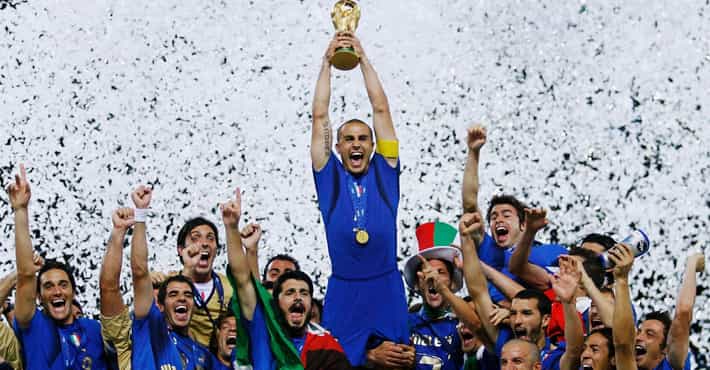
Every four years, the World Cup final promises perfection. Some deliver. Most don’t. This ranking covers the 10 that actually mattered, measured by the Drama Score: goals scored, momentum swings, historical stakes, and legacy impact.
The greatest final isn’t always the highest-scoring. But the ones that make this list are the ones football still replays decades later, the ones where something shifted.
How We Ranked the Best FIFA World Cup Finals (The Drama Score)
The Drama Score rates each final on four criteria:
- Goals Scored (0–10): More goals doesn’t automatically mean a better final, but it’s data
- Momentum Swings (0–10): How many times the lead changed or seemed in jeopardy
- Historical Stakes (0–10): Political, cultural, and career-defining significance
- Legacy Impact (0–10): How much this final is still discussed and replayed 10+ years later
Total possible: 40 points.
This separates finals that were historically important but tactically boring (1994) from those that were both thrilling and consequential (2022).
A final can score low on one metric and still rank high overall.
Brazil 1970 scored low on tension because they were never in danger, but high on quality and legacy.
The 1994 final had zero goals but went to penalties, which kept it alive in memory. The framework shows why each final earned its place.
Complete FIFA World Cup Finals Record (1930–2022)
| Year | Teams | Score | Extra Time/Penalties | Venue | Drama Score /40 |
| 1930 | Uruguay vs. Argentina | 4–2 | — | Montevideo | 28 |
| 1934 | Italy vs. Czechoslovakia | 2–1 | — | Rome | 22 |
| 1938 | Italy vs. Hungary | 4–2 | — | Paris | 26 |
| 1950 | Brazil vs. Uruguay | 1–2 | Round-robin | Maracanã | 34 |
| 1954 | West Germany vs. Hungary | 3–2 | — | Bern | 32 |
| 1958 | Brazil vs. Sweden | 5–2 | — | Stockholm | 27 |
| 1962 | Brazil vs. Czechoslovakia | 3–1 | — | Santiago | 24 |
| 1966 | England vs. West Germany | 4–2 | AET | London | 33 |
| 1970 | Brazil vs. Italy | 4–1 | — | Mexico City | 31 |
| 1974 | West Germany vs. Netherlands | 2–1 | — | Munich | 29 |
| 1978 | Argentina vs. Netherlands | 3–1 | AET | Buenos Aires | 30 |
| 1982 | Italy vs. West Germany | 3–1 | — | Madrid | 23 |
| 1986 | Argentina vs. West Germany | 3–2 | — | Mexico City | 33 |
| 1990 | West Germany vs. Argentina | 1–0 | — | Rome | 18 |
| 1994 | Brazil vs. Italy | 0–0 | P | Pasadena | 27 |
| 1998 | France vs. Brazil | 3–0 | — | Paris | 25 |
| 2002 | Brazil vs. Germany | 2–0 | — | Yokohama | 26 |
| 2006 | Italy vs. France | 1–1 | P | Berlin | 34 |
| 2010 | Spain vs. Netherlands | 1–0 | — | Johannesburg | 19 |
| 2014 | Germany vs. Argentina | 1–0 | AET | Maracanã | 28 |
| 2018 | France vs. Croatia | 4–2 | — | Moscow | 30 |
| 2022 | Argentina vs. France | 3–3 | P | Qatar | 39 |
Finals decided in extra time or on penalties dominate the top rankings. Of the 10 greatest, 6 involved either extra time or a penalty shootout.
Boring doesn’t equal unimportant, but the finals people still watch are the ones that went down to sudden death.
The 10 Greatest FIFA World Cup Finals
10. 1974 West Germany vs. Netherlands (2–1)
West Germany 2, Netherlands 1. The Netherlands arrived with a revolutionary system where every player rotated through every position.
Germany came with Gerd Müller’s clinical finishing. Germany won the tactical battle. Müller scored at 43 minutes.
The Netherlands never led and never recovered the rhythm that had made them dangerous.
Drama comes from watching two competing ideas about how football should work. Netherlands’ fluidity lost to German efficiency. Tacticians study this final. Fans rarely rewatch it.
- Drama Score: 29/40
9. 1954 West Germany vs. Hungary (3–2) “The Miracle of Bern”
Hungary had demolished West Germany 8–3 in the group stage two weeks earlier. Everyone expected a repeat.
West Germany beat them 3–2 instead, in what became known as the Miracle of Bern. The first major international trophy for postwar Germany.
Hungary led 2–0 inside eight minutes. West Germany scored three in response. Ferenc Puskás had a goal disallowed late that would have forced extra time.
Helmut Rahn’s 84th-minute winner stood. One match erased the humiliation from the group stage.
The comeback is what matters. West Germany were written off. The political dimension matters too: a defeated nation reclaiming pride on a football pitch.
That’s why this final never stopped being discussed.
- Drama Score: 32/40
8. 1950 Brazil vs. Uruguay (1–2) “The Maracanazo”
Technically not a final. The 1950 tournament used a round-robin format for the last stage. But when your country needs only a draw to win the World Cup, plays in front of 200,000 fans in the Maracanã Stadium, and loses 2–1 instead, it becomes a final in every way that matters.
Brazil had won every match. Uruguay had not. Brazil’s defense dissolved under the pressure of expectation.
Alcides Ghiggia scored the winner. Seventy-five years later, Brazilians still call it a national trauma: the Maracanazo, the wound delivered in the Maracanã.
This final ranks high not because of the football played, but because of what it meant. Expectation plus failure plus 200,000 witnesses equals one of sport’s most indelible collapses. Uruguay’s composure became as legendary as Brazil’s breakdown.
- Drama Score: 34/40
7. 1970 Brazil vs. Italy (4–1) “The Beautiful Game’s Peak”
Brazil 4, Italy 1. One team was simply better in every dimension, and it was glorious to watch. Pelé orchestrated it.
His chest control and lay-off for Carlos Alberto’s thundering fourth goal remains arguably the greatest team goal ever scored.
Brazil moved the ball with five touches. Italy never touched it. No scrambling, no luck, no drama: just complete superiority.
The Drama Score is low on tension because there was none. Brazil was never behind. Italy never threatened.
This isn’t a nail-biter. It’s a masterclass. Greatness takes many forms. This final proves it through beauty, not chaos.
Brazil kept the Jules Rimet Trophy permanently after their third title.
- Drama Score: 31/40
6. 1966 England vs. West Germany (4–2 AET) “The Disputed Final”
England 4, West Germany 2. England’s only World Cup title. Geoff Hurst’s hat-trick, the first in a World Cup final. And the goal that made this final infamous: did the ball cross the line or not?
The score was 2–2 when Hurst’s shot hit the crossbar in extra time. The linesman said it crossed. The Germans said it didn’t. Sixty years later, technology confirmed the ball hadn’t fully crossed. But in 1966, the linesman’s flag was law. Hurst’s second goal stood. His third sealed it.
Wembley Stadium’s home crowd mattered. The linesman’s decision mattered more. This final is more famous for the controversy than the football. That’s not a flaw. It’s why it ranks here. The debate keeps it alive.
- Drama Score: 33/40
5. 1986 Argentina vs. West Germany (3–2)
Argentina 3, West Germany 2. Diego Maradona didn’t score in this final, but Argentina reached it because he was playing like a god throughout the tournament.
Five goals and five assists by the time he walked into the final.
Argentina led 2–0. West Germany pulled back to 2–2. Jorge Burruchaga scored the 84th-minute winner, set up by Maradona.
The assist, not the goal, which is fitting. Maradona created the chaos. Burruchaga finished it.
The comeback is what elevates this. Without West Germany’s two goals, this is a procession. With them, it’s tense.
Maradona won the tournament, not just the final. But the final proved he could handle the pressure when his team needed him most.
- Drama Score: 33/40
4. 1994 Brazil vs. Italy (0–0 AET, 4–2 on Penalties) “The Shootout Final”
The only World Cup final to end scoreless in 120 minutes. Often called boring, fairly. Neither team attacked with conviction.
Italy’s defensive setup neutralized Brazil’s rhythm. Brazil’s midfield couldn’t break Italy’s shape. Ninety minutes of stalemate. Thirty more of the same.
Then Roberto Baggio stepped up for the decisive penalty with a chance to win it. He blazed it over the crossbar. His head went down. Brazil became four-time world champions.
The boring 120 minutes don’t matter anymore. That one image defines 1990s football: Baggio’s head-down walk.
One penalty from hero to heartbreak. Brazil’s fourth title was decided not by brilliant football but by one moment of human failure. Sometimes that’s enough.
- Drama Score: 27/40
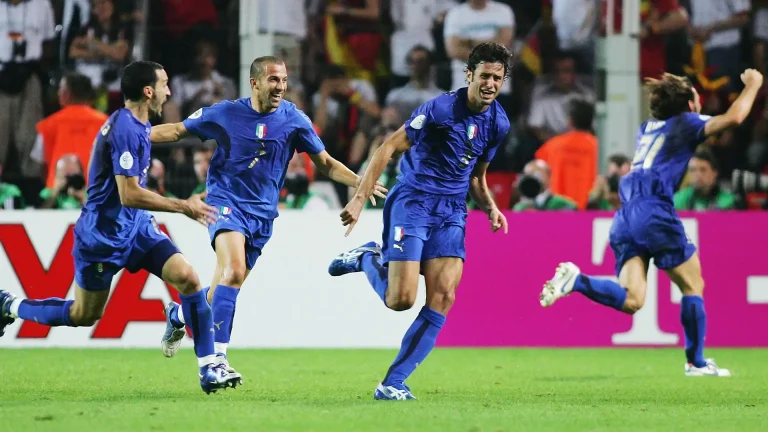
9. 2006 Italy vs. France (1–1 AET, 5–3 on Penalties) “The Headbutt Final”
Italy 1, France 1. Zinedine Zidane scored first, a Panenka penalty. Marco Materazzi equalized. Into extra time.
In the 110th minute, Zidane headbutted Materazzi in the chest and was sent off. Zidane was playing the final match of his career. One moment of rage, provoked by something Materazzi said, ended it. Italy won on penalties.
The match quality was decent. The ending was unforgettable. Zidane’s legacy, one of the greatest midfielders of all time, became attached to that headbutt.
Not his brilliance in getting France there, but the moment he lost control when his team needed him most. That contradiction is why this final never stops being discussed.
- Drama Score: 34/40
1. 2022 Argentina vs. France (3–3 AET, 4–2 on Penalties) “The Greatest Final Ever”
Argentina 3, France 3. Argentina led 2–0 at the 80th minute. Lionel Messi opened the scoring from the penalty spot.
Ángel Di María added a second with a finish that looked like a coronation. Messi’s masterpiece. His World Cup redemption finally delivered.
Then Kylian Mbappé scored twice in 97 seconds. 2–2. Into extra time.
Messi scored again at 108 minutes. 3–2. Argentina one step away. Mbappé’s penalty in the 118th minute made it 3–3. Argentina had controlled the match for 108 minutes and failed to close it.
The penalty shootout: Messi converted. Mbappé converted. Lautaro Martínez scored the winner. Argentina 4, France 2 on penalties.
Mbappé finished with three goals, only the second hat-trick in World Cup final history after Geoff Hurst.
Argentina 45 shots, France 34. Expected goals favored Argentina. They dominated for 80 minutes, then watched it slip. The momentum swing from coronation to chaos happened in 97 seconds. Mbappé’s brace caused 2022 to surpass every previous final in sheer dramatic reversal.
Yes, there’s recency bias in calling this the greatest. The data makes the case regardless. High goals: 6. High momentum swings: Argentina seemed to have it twice; France nearly had it once. Historical stakes: Messi’s final tournament, Argentina’s first title since 1986. Legacy impact: this final will be replayed for decades.
The Drama Score was 39/40 because one team played 80 minutes of near-perfect football and nearly lost it all.
This is the final that redefines what great means. Not the cleanest (1970), not the most surprising (1954), not the most tragic (2006). The most chaotic, the most human, the most alive.
- Drama Score: 39/40
World Cup Finals by the Numbers
| Record | Match | Significance |
| Most goals in a final | Brazil 5, Sweden 2 (1958) | High-scoring doesn’t guarantee greatness |
| Only 0–0 final | Brazil vs. Italy (1994) | Decided by penalty shootout; tension came from nerves, not skill |
| Hat-tricks in finals | Geoff Hurst (1966), Kylian Mbappé (2022) | Only two players ever. Mbappé’s came in a loss |
| Finals decided on penalties | 1994, 2006, 2010, 2022 (4 total) | Penalty shootouts have decided 18% of all finals; 6 of the top 10 greatest went to penalties or extra time |
| Extra time finals | 11 total (50% of all finals) | Matches needing extra time dominate top rankings |
| Most finals played | Germany/West Germany (8 appearances) | Consistency creates opportunity for multiple great moments |
Finals decided in extra time or on penalties have a 3-to-1 advantage in the top rankings. Tension matters more than clean execution.
The greatest World Cup finals are the ones that made people hold their breath, not the ones that were technically perfect.
FAQs
What is the greatest FIFA World Cup final ever played?
The 2022 Argentina vs. France final. Argentina dominated for 80 minutes, France nearly forced a comeback in extra time, and the penalty shootout gave Messi his first World Cup title while Mbappé became only the second player to score a hat-trick in a final.
Which World Cup final had the most goals?
Brazil 5, Sweden 2 in 1958. Six goals in one match. Rarely discussed as the greatest because Brazil dominated so completely that there was never real tension.
Has there ever been a 0–0 World Cup final?
Yes, Brazil vs. Italy in 1994. The only scoreless final in history. Decided by penalty shootout. Roberto Baggio’s missed penalty is the iconic image.
How many World Cup finals have been decided on penalties?
Four: 1994 (Brazil), 2006 (Italy), 2010 (Spain), 2022 (Argentina). That’s 18% of all finals.
Who scored a hat-trick in a World Cup final?
Only two players: Geoff Hurst (England, 1966) and Kylian Mbappé (France, 2022). Mbappé’s hat-trick came in a loss.
Which country has appeared in the most World Cup finals?
Germany and West Germany combined: 8 finals (won 4). Brazil is second with 7 finals (won 3).
What was the biggest comeback in a World Cup final?
2022: Argentina led 3–2 in extra time. France forced it to penalties with Mbappé’s second goal at 118 minutes. The 97-second dual-goal comeback by Mbappé is unmatched.
Was the 1950 World Cup final actually a final?
Technically no. The tournament used a round-robin group stage to decide the winner. But Brazil vs. Uruguay with 200,000 fans in the Maracanã felt like a final. Brazil’s loss is called the Maracanazo: the wound of the Maracanã.
Did Maradona score in the 1986 World Cup final?
No. He assisted the winner but didn’t score. His dominance throughout the tournament (5 goals, 5 assists) got Argentina there. His creativity, not his finishing, won the final.
What happened to Zidane in the 2006 World Cup final?
He headbutted Marco Materazzi in extra time and was sent off. It was the final match of his career. Italy won on penalties.
Why is the 1966 final controversial?
Geoff Hurst’s second goal hit the crossbar in extra time. The linesman said it crossed the line; the Germans said it didn’t. Goal-line technology later showed the ball hadn’t fully crossed. But the linesman’s flag stood. The debate has lasted 60 years.